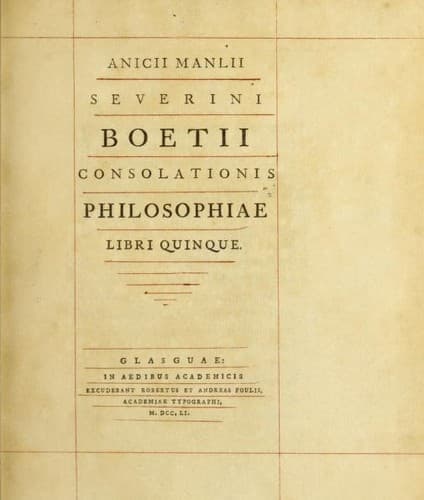
Chaucer's Translation of Boethius's "De Consolatione Philosophiae"Boethius
ReligionComparative
Chaucer's Translation of Boethius's "De Consolatione Philosophiae"
Boethius
Happiness; Philosophy and religion
forþi sorwest þou þat þou art exiled of þi p{ro}pre goodes.
¶ And for þou ne wost what is þe ende of þinges. for[þi] demest [þou]
þat felono{us} {and} wikked men ben myȝty {and} weleful for þou hast
forȝeten by whiche gouernementȝ þe worlde is gouerned. ¶ Forþi wenest
þou þat þise mutac{i}ou{n}s of fortune fleten wiþ oute{n} gouerno{ur}.
þise ben grete causes not oonly to maladie. but certes grete causes to
deeþ ¶ But I þanke þe auctour {and} þe makere of heele þat nat{ur}e haþ
not al forleten þe. {and} I haue g[r]ete norissinges of þi hele. {and}
þat is þe soþe sentence of gou{er}nau{n}ce of þe worlde. þat þou
byleuest þat þe gou{er}nynge of it nis nat subgit ne vnderput to þe
folie of þise happes auenterouses. but to þe resou{n} of god ¶ And þer
fore doute þe noþing. For of þis litel spark þine heet of lijf schal
shine. ¶ But for as muche as it is not tyme ȝitte of fastere remedies
¶ And þe nature of þouȝtes disseiued is þis þat as ofte as þei casten
aweye soþe opyniou{n}s: þei cloþen hem in fals[e] opiniou{n}s. [of
which{e} false opyniou{n}s] þe derknesse of p{er}turbac{i}ou{n} wexeþ
vp. þat comfoundeþ þe verray insyȝt. {and} þat derkenes schal .I. say
somwhat to maken þi{n}ne {and} wayk by lyȝt {and} meenelyche remedies.
so þat after þat þe derknes of desseyuynge desyrynges is don awey. þou
mow[e] knowe þe schynyng of verray lyȝt.
NUBIB{US} ATRIS CONDITA.
[Sidenote: [The seuende Metyr.]]
++ÞE sterres cou{er}ed wiþ blak[e] cloudes ne mowen geten a dou{n} no
lyȝt. Ȝif þe trouble wy{n}de þat hyȝt auster stormynge {and} walwy{n}g
þe see medleþ þe heete þat is to seyne þe boylyng vp from þe botme ¶ Þe
wawes þ{a}t somtyme weren clere as glas {and} lyke to þe fair[e]
bryȝt[e] dayes wiþstant anon þe syȝtes of men. by þe filþe {and} ordure
þat is resolued. {and} þe fletyng streme þat royleþ dou{n} dyuersely fro
heyȝe mou{n}taignes is arestid {and} resisted ofte tyme by þe
encountrynge of a stoon þ{a}t is dep{ar}tid {and} fallen from some
roche. ¶ And forþi yif þou wilt loken {and} demen soþe wiþ clere lyȝt.
{and} holde þe weye wiþ a ryȝt paþe. ¶ Weyue þou ioie. drif fro þe
drede. fleme þou hope. ne lat no sorwe ap{ro}che. þat is to sein lat
noon of þise four passiou{n}s ouer come þe. or blynde þe. for cloudy
{and} dirke is þilk þouȝt {and} bounde w{i}t{h} bridles. where as þise
þinges regnen.
EXPLICIT LIBER PRIMUS.
INCIPIT LIBER SECUNDUS.
POSTEA [PAU]LISPER CONTICUIT.
[Sidenote: [The fyrst p{ro}se.]]
Public-domain text, read in full here on John Shaqi.
Reviews
Reviews
No reviews yet
Be the first to share your thoughts on this work.
Elsewhere in the archive
Join the Discussion
Join the discussion
Sign in to leave a comment or review.
Sign InorCreate an account