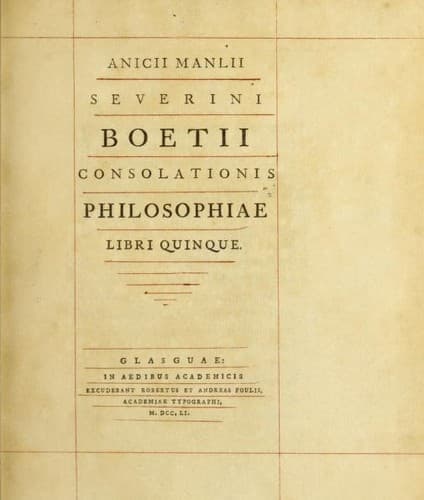
Chaucer's Translation of Boethius's "De Consolatione Philosophiae"Boethius
ReligionComparative
Chaucer's Translation of Boethius's "De Consolatione Philosophiae"
Boethius
Happiness; Philosophy and religion
++After þis she stynte a litel. and after þat she hadde gadred by
atempre stillenesse myn attenciou{n} she seide þus. ¶ As who so myȝt[e]
seye þus. After þise þinges she stynt[e] a lytel. {and} whanne she
ap{er}ceiued[e] by atempre stillenesse þat I was ententif to herkene
hire. she bygan to speke in þis wyse. ¶ Yif I q{uod} she haue
vnderstonde{n} {and} knowe vtterly þe causes {and} þe habit of þi
maladie. þou languissed {and} art deffeted for talent {and} desijr of þi
raþer fortune. ¶ She þat ilke fortune only þat is chaunged as þou
feinest to þe ward. haþ p{er}uerted þe clerenesse {and} þe astat of þi
corage. ¶ I vnderstonde þe felefolde colo{ur} {and} deceites of þilke
merueillous monstre fortune. and how she vseþ ful flatryng familarite
wiþ hem þat she enforceþ to bygyle. so longe til þat she co{n}founde wiþ
vnsuffreable sorwe hem þat she haþ left in despeir vnpurueyed. ¶ and if
þou remembrest wel þe kynde þe maners {and} þe desert of þilke fortune.
þow shalt wel knowe as in hir þou neuer ne haddest ne hast ylost any
fair þing. But as I trowe I shal not gretly trauaile to don þe remembren
of þise þinges. ¶ For þou were wont to hurtlen [{and} despysen] hir wiþ
manly wordes whan she was blaundissinge {and} presente {and}
p{ur}sewedest hir wiþ sentences þat were drawe{n} oute of myne entre.
þat is to seyne out of myn i{n}formac{i}ou{n} ¶ But no sudeyne
mutac{i}ou{n} ne bytideþ nat wiþ oute{n} a maner chau{n}gyng of curages.
and so is it byfallen þat þou art dep{ar}ted a litel fro þe pees of þi
þouȝt. but now is tyme þat þou drynke {and} atast[e] some softe {and}
delitable þinges. so þat whan þei ben entred wiþ i{n}ne þe. it mow make
weye to strenger drynkes of medycynes. ¶ Com nowe furþe þerfore þe
suasiou{n} of swetnesse Rethoryen. whiche þat goþ oonly þe ryȝt wey whil
she forsakeþ not myne estatutȝ. ¶ And wiþ Rethorice com forþe musice a
damoisel of oure house þat syngeþ now lyȝter moedes or p{ro}lac{i}ou{n}s
now heuyer. what ayleþ þe man. what is it þat haþ cast þe in to murnyng
{and} in to wepyng. I trow[e] þat þou hast sen some newe þing {and}
uncouþe. ¶ Þou wenest þat fortune be chaunged aȝeins þe ¶ But þou wenest
wrong. yif þou [þat] wene. Alwey þo ben hire maners. she haþ raþer
[kept] as to þe ward hire p{ro}pre stablenes in þe chaungyng of hyre
self. ¶ Ryȝt swyche was she whan she flatered[e] þe. {and} desseiued[e]
þe wiþ vnleueful lykynges of false welefulnesse. þou hast now knowen
{and} ataynt þe doutous or double visage of þilke blynde goddesse
fortune. ¶ She þat ȝit couereþ hir {and} wympleþ hir to oþer folk. haþ
shewed hir euerydel to þe. ¶ Ȝif þou app{ro}uest hir {and} þenkest þat
she is good. vse hir maners {and} pleyne þe nat. ¶ And if þou agrisest
hir fals[e] trecherie. dispise {and} cast aweye hir þat pleyeþ so
harmefully. for she þat is now cause of so myche sorwe to þe. sholde be
to þe cause of pees {and} [of] ioie. ¶ she haþ forsaken þe forsoþe. þe
whiche þat neuer man may be syker þat she ne shal forsake hym. _Glose._
Public-domain text, read in full here on John Shaqi.
Reviews
Reviews
No reviews yet
Be the first to share your thoughts on this work.
Elsewhere in the archive
Join the Discussion
Join the discussion
Sign in to leave a comment or review.
Sign InorCreate an account