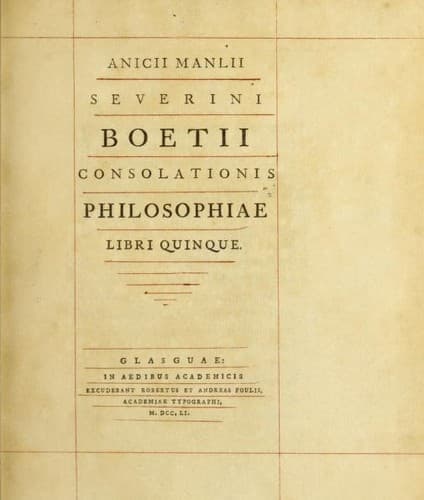
Chaucer's Translation of Boethius's "De Consolatione Philosophiae"Boethius
ReligionComparative
Chaucer's Translation of Boethius's "De Consolatione Philosophiae"
Boethius
Happiness; Philosophy and religion
¶ Allas now lieþ he emptid of lyȝt of hys þouȝt. {and}
hys nekke is p{re}ssid wiþ heuy cheynes {and} bereþ his
chere enclined adoune for þe greet[e] weyȝt. and is
constreyned to loke on foule erþe. 124
[Linenotes:
101 _gone_--goon
102 _bisines_--bysynesse
_outen_--owte
103 _worldly_--wordely
104 _sumtyme_--whilom
105 _gone_--goon
106 _paþes_--paathes
_sauȝ_--sawh
_lyȝtnesse_--lythnesse
_sunne_--sonne
_sauȝ_--MS. sue, C. sawgh
107 _wyche_--which
108 _risorses_--recourses
111 _seche_--seken
_sounyng_--sownynge
114 _ryseþ oute_--aryseth owt
_falle_--fallen
115 _westren_--westrene
116 _fyrste_--fyrst
119 _eke_--ek
120 _dyuerses_--diuerse
_yhid_--MS. yhidde
121 _lieþ_--lith
_emptid_--emted
123 _adoune_--adown
_greet[e] weyȝt_--grete weyhte
124 _loke----foule_--looken on the fool]
[Headnote:
PHILOSOPHY ENLIGHTENS BOETHIUS.]
SET MEDICINE INQUIT TEMPUS.
[Sidenote: [The ij^de p{ro}se.]]
[Sidenote: More need of medicine than of complaint.]
++Bvt tyme is now q{uo}d sche of medicine more þen of
compleynte. ¶ Forsoþe þen sche entendyng to
me warde wiþ al þe lokyng of hir eyen saide.
[Sidenote: Philosophy addresses Boethius.]
¶ Art
not þou he q{uo}d sche þat su{m}tyme I-norschid wiþ my 128
mylke {and} fostre[d] wiþ my meetes were ascaped {and}
comen to corage of a p{er}fit man. ¶ Certys I ȝaf þe
syche armures þat ȝif þou þi self ne haddest first caste [[pg 9]]
hem away. þei schulden haue defendid þe in sykernesse 132
þat may not be ouer-comen. ¶ Knowest þou me not.
[Sidenote: She fears his silence proceeds from shame rather than
from stupidity.]
[Sidenote: [* fol. 4 _b_.]]
*Why art þou stille. is it for schame or for astonynge.
It were me leuer þat it were for schame. but it semeþ
me þat astony{n}ge haþ opp{re}ssed þe.
[Sidenote: She finds him, however, in a lethargy, the distemper of
a disordered mind.]
¶ And whan 136
sche say me not oonly stille. but wiþ-outen office of
tonge {and} al doumbe. sche leide hir honde softely vpon
my brest {and} seide. ¶ Here nis no p{er}il q{uod} sche.
¶ He is fallen in to a litargie. whiche þat is a comune 140
sekenes to hertes þat ben desceiued. ¶ He haþ a litel
forȝeten hym self. but certis he schal lyȝtly reme{m}bren
hym self. ¶ Ȝif so be þat he haþ knowe{n} me or now.
[Sidenote: To make his recovery an easy matter, she wipes his
eyes, which were darkened by the clouds of mortal things, and
dries up his tears.]
Public-domain text, read in full here on John Shaqi.
Reviews
Reviews
No reviews yet
Be the first to share your thoughts on this work.
Join the Discussion
Join the discussion
Sign in to leave a comment or review.
Sign InorCreate an account