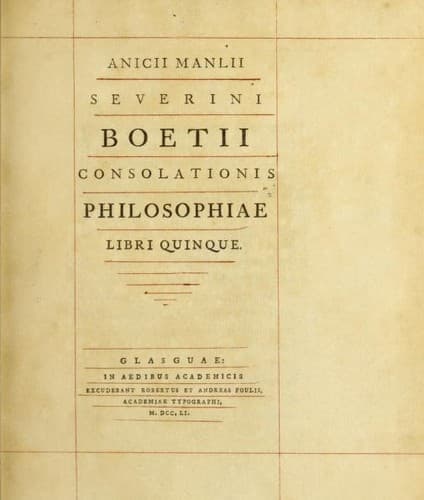
Chaucer's Translation of Boethius's "De Consolatione Philosophiae"Boethius
ReligionComparative
Chaucer's Translation of Boethius's "De Consolatione Philosophiae"
Boethius
Happiness; Philosophy and religion
[Sidenote: Thus, clothed with her spoils, they deceived many.]
In whiche epicuryens {and} stoyciens. for as
myche as þer semed[e] so{m}me traces {and} steppes of
myne habit.
[Sidenote: [* fol. 5.]]
þe folye of men wenyng þo epicuryens 200
{and} stoyciens my *familers p{er}uertede (.s. p{er}sequend{o})
so{m}me þoruȝ þe errour of þe wikked[e] or vnkunnyng[e]
multitude of hem.
[Sidenote: Philosophy adduces examples of wise men, who had
laboured under difficulties on account of being her disciples.]
¶ Þis is to seyne for þei
semeden philosophres: þei weren p{ur}sued to þe deeþ 204
and slayn. ¶ So yif þou hast not knowen þe exilynge
of anaxogore. ne þe empoysenyng of socrates. ne þe
to{ur}mentȝ of ȝeno for þei [weren] straungers. ¶ Ȝit
myȝtest þou haue knowe{n} þe senectiens {and} þe Canyos 208
{and} þe sorancis of wyche folk þe renou{n} is neyþer ouer
oolde ne vnsolempne. ¶ Þe whiche men no þing ellys
ne brouȝt[e] hem to þe deeþ but oonly for þei weren
enfourmed of my maneres. {and} semede{n} moste vnlyke 212
to þe studies of wicked folk. ¶ And forþi þou auȝtest
not to wondre þouȝ þ{a}t I in þe bitter see of þis lijf be
fordryuen wiþ tempestes blowyng aboute. [[pg 12]]
[Sidenote: It is the aim of Philosophy to displease the wicked,
who are more to be despised than dreaded, for they have no
leader.]
in þe whiche
te{m}peste þis is my most p{ur}pos þat is to seyn to displese 216
to wikked[e] men. ¶ Of whiche schrews al be
þe oost neuer so grete it is to dispyse. for it nis gouerned
wiþ no leder of resoune. but it is rauysched only by
flityng errour folyly {and} lyȝtly.
[Sidenote: If Philosophy is attacked by the wicked, she retires
within her fortress, leaving the enemy busy among the useless
baggage, and laughing to scorn such hunters of trifles.]
¶ And if þei somtyme 220
maky{n}g an ost aȝeynest vs assaile vs as strengere. oure
leder draweþ to gedir hys rycchesse i{n} to hys toure.
{and} þei ben ententif aboute sarpulers or sachels vnp{ro}fitable
forto taken. but we þat ben heyȝ abouen syker 224
fro al tumulte {and} wode noise. ben stored {and} enclosed
in syche a palays. whider as þat chateryng or anoying
folye ne may not attayne. ¶ We scorne swiche
rauiners {and} honters of foulest[e] þinges. 228
Public-domain text, read in full here on John Shaqi.
Reviews
Reviews
No reviews yet
Be the first to share your thoughts on this work.
Join the Discussion
Join the discussion
Sign in to leave a comment or review.
Sign InorCreate an account