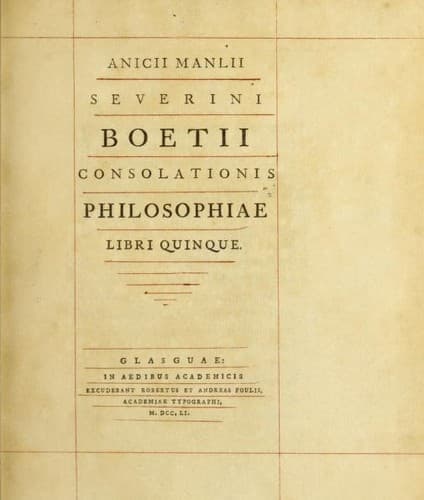
Chaucer's Translation of Boethius's "De Consolatione Philosophiae"Boethius
ReligionComparative
Chaucer's Translation of Boethius's "De Consolatione Philosophiae"
Boethius
Happiness; Philosophy and religion
++Who so it be þat is clere of vertue sad {and} wel ordinat
of lyuyng. þat haþ put vnderfote þe prowed[e]
wierdes {and} lokiþ vpryȝt vpon eyþer fortune. he may
holde hys chiere vndiscomfited. ¶ Þe rage ne þe manace 232
of þe co{m}moeuyng or chasyng vpwarde hete fro þe
botme. ne schal not moeue þat man. ne þe vnstable
mountaigne þat hyȝt veseuus. þat wircheþ oute þoruȝ
hys broken[e] chemineys smokyng fires. ¶ Ne þe wey 236
of þonder lyȝt þat is wont to smyte heyȝe toures ne
schal not mouene þat man.
[Sidenote: Fear not the tyrant’s rage.]
¶ Wherto þen wrecches
drede ȝe tyrauntes þat ben wode {and} felownes wiþ-outen
ony strenkeþ.
[Sidenote: He who neither fears nor hopes for anything disarms the
tyrant.]
¶ Hope after no þing ne drede nat. {and} 240
so schalt þou desarmen þe ire of þilke vnmyȝty tyraunt. [[pg 13]]
[Sidenote: He whose heart fails him, yields his arms, and forges
his own fetters.]
¶ But who so þat quakyng dredeþ or desireþ þing þat
nis not stable of his ryȝt. þat man þat so doþ haþ cast
awey hys schelde {and} is remoeued fro hys place. {and} 244
enlaceþ hym i{n} þe cheyne wiþ whiche he may be
drawen.
[Linenotes:
229 _clere_--cleer
230 _lyuyng_--leuynge
_haþ_--MS. haþe
_vnderfote_--vndir-foot
_prowed[e]_--prowde
231 _may----chiere_--may his cheere holde
232 _manace_--manesses
233 _þe_--þe see
235 _hyȝt_--hihte
_veseuus_--MS. vesenus
_wircheþ_--writith
236 _broken[e]_--brokene
_smokyng_--smokynge
237 _smyte_--smyten
238 _Wherto þen_--wharto thanne
239 _felownes----ony_--felonos withowte any
241 _schalt þou desarmen_--shaltow deseruien
243 _doþ_--MS. doþe, C. doth
_haþ_--MS. haþe, C. hath
_cast_--MS. caste, C. cast
244 _schelde_--sheld
_remoeued fro_--remwed from
245 _whiche_--the which
_be_--ben]
[Headnote:
BOETHIUS SPEAKS OF HIS TROUBLES.]
SENTIS NE INQUIT.
[Sidenote: [The verthe p{ro}se.]]
[Sidenote: Philosophy seeks to know the malady of Boethius.]
++FElest þou q{uod} sche þise þinges {and} entren þei ouȝt
in þi corage. ¶ Art þou like an asse to þe harpe. 248
Whi wepest þou whi spillest þou teres. ¶ Yif þou
abidest after helpe of þi leche. þe byhoueþ discouere þi
wounde.
[Sidenote: Boethius complains of Fortune’s unrelenting rage.]
¶ Þo .I. þat hadde gadered strenkeþ in my
corage answered[e] {and} seide. {and} nedeþ it ȝitte q{uod} 252
.I. of rehersyng or of amonic{i}ou{n}. {and} scheweþ it not
ynouȝ by hym self þe scharpnes of fortune þat wexeþ
woode aȝeynes me.
[Sidenote: Is not she moved, he asks, with the aspect of his
prison?]
¶ Ne moeueþ it nat þe to seen þe
face or þe man{er}e of þis place (.i. p{r}isou{n}.).
Public-domain text, read in full here on John Shaqi.
Reviews
Reviews
No reviews yet
Be the first to share your thoughts on this work.
Join the Discussion
Join the discussion
Sign in to leave a comment or review.
Sign InorCreate an account