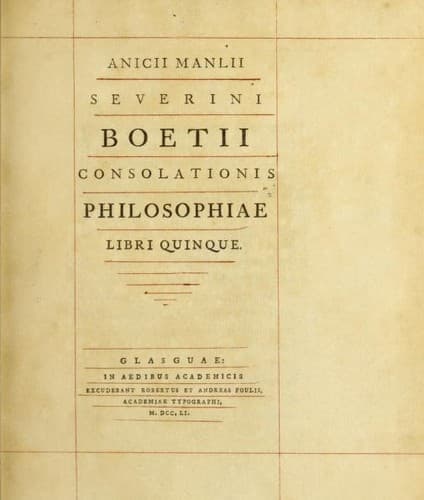
Chaucer's Translation of Boethius's "De Consolatione Philosophiae"Boethius
ReligionComparative
Chaucer's Translation of Boethius's "De Consolatione Philosophiae"
Boethius
Happiness; Philosophy and religion
[Sidenote: His library, his habit, and his countenance are all
changed.]
¶ Is þis 256
þe librarie wyche þat þou haddest chosen for a ryȝt
certeyne sege to þe i{n} myne house. ¶ Þere as þou
desputest of[te] wiþ me of þe sciences of þinges touching
diuinitee {and} touchyng mankynde. ¶ Was þan 260
myn habit swiche as it is now. was þan my face or
[Interlinear: quasi d{ice}ret non.]
my chere swiche as now.
¶ Whan I souȝt[e] wiþ þe
secretys of nature. whan þou enfo{ur}medest my maners
{and} þe resou{n} of al my lijf. to þe ensaumple of þe ordre 264
of heuene.
[Sidenote: Is this, he asks, the reward of his fidelity?]
[Interlinear: ironice]
¶ Is nat þis þe gerdou{n} þat I refere to þe
to whom I haue be obeisaunt. ¶ Certis þou enfo{ur}medist
by þe mouþe of plato þis sentence.
[Sidenote: Plato (de Rep. v.) says that those Commonwealths are
most happy that are governed by philosophers, or by those who
study to be so.]
þat is to
seyne þat co{m}mune þinges or comunabletes weren 268
blysful yif þei þat haden studied al fully to wisdom [[pg 14]]
gouerneden þilke þinges.
[Sidenote: [* fol. 5 _b_.]]
or ellys yif it so by-felle þat
þe gouernours *of co{m}munalites studieden in grete wisdomes.
[Linenotes:
247 _Felest þou_--Felistow
_ouȝt_--awht
248 _art þou_--artow
249 _wepest þou_--wepistow
_spillest þou_--spillestow
252 _answered[e]_--answerede
255 _woode_--wood
257 _wyche_--which
258 _myne house þere_--myn hows ther
259 _desputest of[te]_--desputedest ofte
260 _þan_--thanne
261 _it_ and _þan_--both omitted
261, 262 _swiche_--swich
262 _souȝt[e]_--sowhte
263 _secretys_--secretȝ
_my_--MS. me, C. my
264 _al_--alle
265 _gerdoun_--gerdouns
266 _enfourmedist_--conformedest
267 _mouþe_--mowht
268 _comunabletes_--comunalitees
270 _by-felle_--byfille
271 _in grete wisdomes_--to geten wysdom]
[Headnote:
PHILOSOPHERS TO BE POLITICIANS.]
[Sidenote: The same Plato urged philosophers to take upon them the
management of public affairs, lest it should fall into the hands
of unprincipled citizens.]
¶ Þou saidest eke by þe mouþe of þe same 272
plato þat it was a necessarie cause wyse men to taken
{and} desire þe gou{er}nau{n}ce of comune þi{n}ges. for þat þe
gou{er}nementes of comune citees y-left in þe hondes of
felonous to{ur}mento{ur}s Citiȝenis ne scholde not brynge 276
inne pestile{n}ce {and} destrucc{i}ou{n} to goode folk.
[Sidenote: Boethius declares that he desired to put in practice
(in the management of public affairs) what he had learnt in his
retirement.]
Public-domain text, read in full here on John Shaqi.
Reviews
Reviews
No reviews yet
Be the first to share your thoughts on this work.
Join the Discussion
Join the discussion
Sign in to leave a comment or review.
Sign InorCreate an account