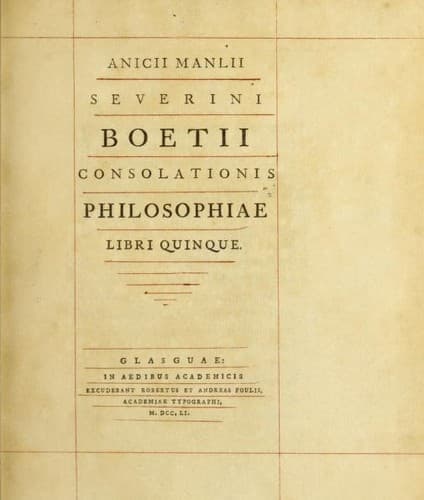
Chaucer's Translation of Boethius's "De Consolatione Philosophiae"Boethius
ReligionComparative
Chaucer's Translation of Boethius's "De Consolatione Philosophiae"
Boethius
Happiness; Philosophy and religion
That, that the se, that gredy is to flowen,
Constreyneth to a certeyn ende so
Hise flodes, that so fiersly they ne growen
To drenchen erth and alle for everemo;
And if that Love aught lete his brydel go,
Al that now loveth asonder sholde lepe,
And lost were al that Love halt now to kepe.
(_Ibid._ st. 244, 245.)
IV. MUTABILITY DIRECTED AND LIMITED BY AN IMMUTABLE AND DIVINE
INTELLIGENCE.
That same prynce and moevere eek, quod he,
Hath stabled, in this wrecched world adoun,
Certeyn dayes and duracioun
To alle that er engendrid in this place,
Over the whiche day they may nat pace,
Al mowe they yit wel here dayes abregge;
. . . . . . . . . . . . . .
Than may men wel by this ordre discerne
That thilke moevere stabul is and eterne.
. . . . . . . . . . . . . .
And therfore of his wyse purveaunce
He hath so wel biset his ordenaunce,
That spices of thinges and progressiouns
Schullen endure by successiouns
And nat eterne be, withoute any lye.
(_Knightes Tale_, vol. ii. p. 92, 93.)
Þe engendrynge of alle þinges quod she and alle þe progressiouns
of muuable nature. and alle þat moeueþ in any manere takiþ hys
causes. hys ordre. and hys formes. of þe stablenesse of þe deuyne
þouȝt [and thilke deuyne thowht] þat is yset and put in þe toure.
þat is to seyne in þe heyȝt of þe simplicite of god. stablisiþ
many manere gyses to þinges þat ben to don.
(_Chaucer’s Boethius_, bk. iv. pr. 6, p. 134.)
V. THE PART IS DERIVED FROM THE WHOLE, THE IMPERFECT FROM THE PERFECT.
Wel may men knowe, but it be a fool,
That every partye dyryveth from his hool.
For nature hath nat take his bygynnyng
Of no partye ne cantel of a thing,
But of a thing that parfyt is and stable,
Descendyng so, til it be corumpable.
(_Knightes Tale_, vol. ii. p. 92.)
For al þing þat is cleped inperfit . is proued inperfit by þe
amenusynge of perfeccioun . or of þing þat is perfit . and her-of
comeþ it . þat in euery þing general . yif þat . þat men seen any
þing þat is inperfit . certys in þilke general þer mot ben somme
þing þat is perfit. For yif so be þat perfeccioun is don awey .
men may nat þinke nor seye fro whennes þilke þing is þat is cleped
inperfit . For þe nature of þinges ne token nat her bygynnyng of
þinges amenused and inperfit . but it procediþ of þingus þat ben
al hool . and absolut . and descendeþ so doune in-to outerest
þinges and in-to þingus empty and wiþ-oute fruyt . but as I haue
shewed a litel her byforne . þat yif þer be a blisfulnesse þat be
frele and vein and inperfit . þer may no man doute . þat þer nys
som blisfulnesse þat is sad stedfast and perfit.’
(bk. iii. pr. 10, p. 89.)
Public-domain text, read in full here on John Shaqi.
Reviews
Reviews
No reviews yet
Be the first to share your thoughts on this work.
Join the Discussion
Join the discussion
Sign in to leave a comment or review.
Sign InorCreate an account