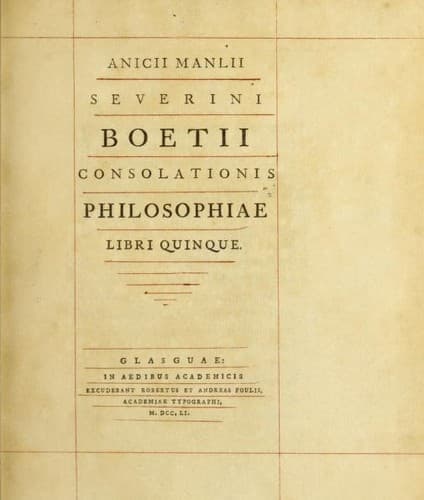
Chaucer's Translation of Boethius's "De Consolatione Philosophiae"Boethius
ReligionComparative
Chaucer's Translation of Boethius's "De Consolatione Philosophiae"
Boethius
Happiness; Philosophy and religion
Omne enim quod imperfectum esse dicitur, id deminutione perfecti
imperfectum esse perhibetur. Quo fit ut si in quolibet genere
imperfectum quid esse videatur, in eo perfectum quoque aliquod
esse necesse sit. Etenim perfectione sublata, unde illud, quod
imperfectum perhibetur, extiterit, ne fingi quidem potest. _Neque
enim ab diminutis inconsummatisque natura rerum cepit exordium,
sed ab integris absolutisque procedens in hæc extrema atque effœta
dilabitur._ Quod si, uti paulo ante monstravimus, est quædam boni
fragilis imperfecta felicitas, esse aliquam solidam perfectamque
non potest dubitari.
(_Boeth._, lib. iii. pr. 10.)
VI. GENTILITY.
For gentilnesse nys but renomé
Of thin auncestres, for her heigh bounté
Which is a straunge thing to thy persone.
(_The Wyf of Bathes Tale_, vol. ii. p. 241.)
For if þe name of gentilesse be referred to renoun and clernesse
of linage. þan is gentil name but a foreine þing.
(_Chaucer’s Boethius_, p. 78.)
_Quæ_ [nobilitas], _si ad claritudinem refertur, aliena est._
(_Boethius_, lib. iii. pr. 6.)
VII. NERO’S CRUELTY.
No teer out of his eyen for that sighte
Ne cam; but sayde, a fair womman was sche.
Gret wonder is how that he couthe or mighte
Be domesman on hir dede beauté.
(_The Monkes Tale_, vol. iii. p. 217.)
Ne no tere ne wette his face, but he was so hard-herted þat he
myȝte ben domesman or iuge of hire dede beauté.
(_Chaucer’s Boethius_, p. 55.)
Ora non tinxit lacrymis, sed esse
Censor extincti potuit decoris.
(_Boethius_, lib. ii. met. 6.)
VIII. PREDESTINATION AND FREE-WILL.
In ‘Troylus and Cryseyde’ we find the following long passage taken from
Boethius, book v. prose 2, 3.
Book iv. st. 134, vol. iv. p. 339.
(1) Syn God seth every thynge, out of doutaunce,
And hem disponeth, thorugh his ordinaunce,
In hire merites sothely for to be,
As they shul comen by predesteyné
136
(2) For som men seyn if God seth al byforne,
Ne God may not deseyved ben pardé!
Than moot it fallen, theigh men hadde it sworne,
That purveyaunce hath seyn befor to be,
Wherfor I seye, that, from eterne, if he
Hathe wiste byforn our thought ek as oure dede,
We have no fre choys, as thise clerkes rede.
137
(3) For other thoughte, nor other dede also,
Myghte nevere ben, but swich as purveyaunce,
Which may nat ben deceyved nevere moo,
Hath feled byforne, withouten ignoraunce;
For if ther myghte ben a variaunce,
To wrythen out fro Goddes purveyinge,
Ther nere no prescience of thynge comynge;
138
(4) But it were rather an opinyon
Uncertein, and no stedfast forseynge;
And certes that were an abusyon
That God shold han no parfit clere wetynge,
More than we men, that han douteous wenynge,
But swich an erroure upon God to gesse
Were fals, and foule, and wikked corsednesse.
139
Public-domain text, read in full here on John Shaqi.
Reviews
Reviews
No reviews yet
Be the first to share your thoughts on this work.
Join the Discussion
Join the discussion
Sign in to leave a comment or review.
Sign InorCreate an account