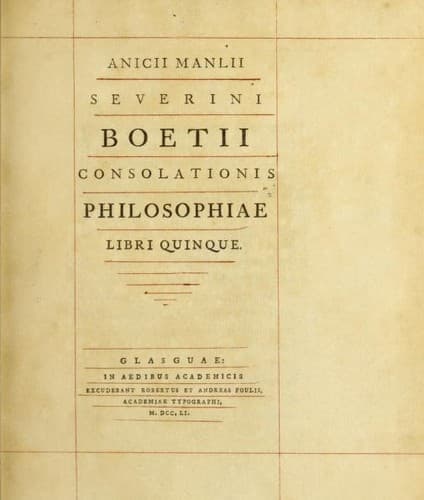
Chaucer's Translation of Boethius's "De Consolatione Philosophiae"Boethius
ReligionComparative
Chaucer's Translation of Boethius's "De Consolatione Philosophiae"
Boethius
Happiness; Philosophy and religion
¶ But no sudeyne mutac{i}ou{n} ne 752
bytideþ nat wiþ oute{n} a maner chau{n}gyng of curages.
and so is it byfallen þat þou art dep{ar}ted a litel fro
þe pees of þi þouȝt.
[Sidenote: But with some gentle emollients I shall prepare thee
for stronger medicines.]
but now is tyme þat þou drynke
{and} atast[e] some softe {and} delitable þinges. so þat whan 756
þei ben entred wiþ i{n}ne þe. it mow make weye to
strenger drynkes of medycynes.
[Sidenote: Approach then, Rhetoric, with thy persuasive charms,
and therewith let Music also draw near.]
¶ Com nowe furþe
þerfore þe suasiou{n} of swetnesse Rethoryen. whiche
þat goþ oonly þe ryȝt wey whil she forsakeþ not myne 760
estatutȝ. ¶ And wiþ Rethorice com forþe musice a
damoisel of oure house þat syngeþ now lyȝter moedes
or p{ro}lac{i}ou{n}s now heuyer. [[pg 31]]
[Sidenote: [* fol. 9.]]
*what ayleþ þe man. what
is it þat haþ cast þe in to murnyng {and} in to wepyng. 764
I trow[e] þat þou hast sen some newe þing {and} uncouþe.
[Sidenote: Thou thinkest that Fortune is changed towards thee.]
¶ Þou wenest þat fortune be chaunged aȝeins þe
[Sidenote: But thou art deceived.]
¶ But þou wenest wrong. yif þou [þat] wene.
[Sidenote: In this misadventure of thine she hath preserved her
constancy in changing.]
Alwey þo ben hire maners. she haþ raþer [kept] as to 768
þe ward hire p{ro}pre stablenes in þe chaungyng of hyre
self. ¶ Ryȝt swyche was she whan she flatered[e]
þe. {and} desseiued[e] þe wiþ vnleueful lykynges of
false welefulnesse.
[Sidenote: You have seen the double face of this blind divinity.]
þou hast now knowen {and} ataynt 772
þe doutous or double visage of þilke blynde goddesse
fortune. ¶ She þat ȝit couereþ hir {and} wympleþ hir
to oþer folk. haþ shewed hir euerydel to þe. ¶ Ȝif
þou app{ro}uest hir {and} þenkest þat she is good. vse 776
hir maners {and} pleyne þe nat.
[Sidenote: If thou dost abhor her perfidy cast her off, for her
sports are dangerous.]
¶ And if þou agrisest
hir fals[e] trecherie. dispise {and} cast aweye hir þat
pleyeþ so harmefully. for she þat is now cause of so
myche sorwe to þe. sholde be to þe cause of pees {and} 780
[of] ioie. ¶ she haþ forsaken þe forsoþe. þe whiche
þat neuer man may be syker þat she ne shal forsake
hym. _Glose._ ¶ But naþeles some bookes han þe text
þus. For soþe she haþ forsaken þe ne þer nis no man 784
syker þat she ne haþ not forsaken.
[Sidenote: Is that happiness which is so transient?]
¶ Holdest þou
þan þilke welefulnesse p{re}ciouse to þe þat shal passen.
[Sidenote: Is the attendance of Fortune so dear to thee, whose
stay is so uncertain, and whose removal causes such grief?]
Public-domain text, read in full here on John Shaqi.
Reviews
Reviews
No reviews yet
Be the first to share your thoughts on this work.
Elsewhere in the archive
Join the Discussion
Join the discussion
Sign in to leave a comment or review.
Sign InorCreate an account