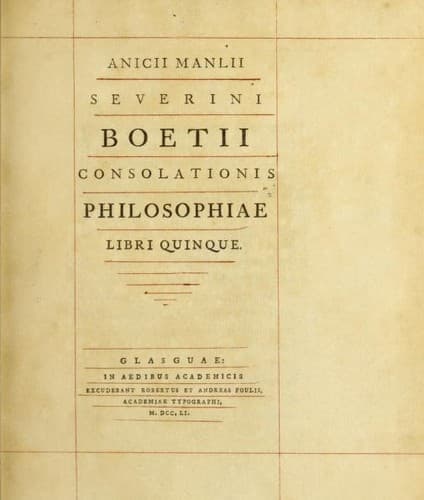
Chaucer's Translation of Boethius's "De Consolatione Philosophiae"Boethius
ReligionComparative
Chaucer's Translation of Boethius's "De Consolatione Philosophiae"
Boethius
Happiness; Philosophy and religion
_Philosophie._ ¶ App{er}teineþ q{uo}d she any of þilke 1221
þinges to þe. whi darst þou glorifie þe in þe shynynge
of any swiche þinges.
[Sidenote: Do the flowers adorn you with their variety?]
Art þou distingwed {and} embelised
by þe spryngyng floures of þe first somer 1224
sesou{n}. or swelliþ þi plente in fruytes of somer. whi
art þou rauyshed wiþ ydel ioies.
[Sidenote: Why embracest thou things wherein thou hast no
property?]
why enbracest þou
straunge goodes as þei weren þine.
[Sidenote: Fortune can never make that thine which the nature of
things forbids to be so.]
Fortune shal neuer
maken þat swiche þinges ben þine þat nature of þinges 1228
maked foreyne fro þe.
[Sidenote: The fruits of the earth are designed for the support of
beasts.]
¶ Syche is þat wiþ-oute{n}
doute þe fruytes of þe erþe owen to ben on þe
norssinge of bestes.
[Sidenote: If you seek only the necessities of nature, the
affluence of Fortune will be useless.]
¶ And if þou wilt fulfille þi
nede after þat it suffiseþ to nature þan is it no nede 1232
þat þou seke after þe sup{er}fluite of fortune.
[Sidenote: Nature is content with a little, and superfluity will
be both disagreeable and hurtful.]
¶ For
wiþ ful fewe þinges {and} w{i}t{h} ful lytel þing nature
halt hire appaied. {and} yif þou wilt achoken þe fulfillyng
of nat{ur}e wiþ sup{er}fluites ¶ Certys þilke 1236
þinges þ{a}t þou wilt þresten or pouren in to nature
shullen ben vnioyeful to þe or ellis anoies.
[Sidenote: Does it add to a man’s worth to shine in variety of
costly clothing?]
¶ Wenest
þou eke þat it be a fair þinge to shine wiþ dyuerse
cloþing.
[Sidenote: The things really to be admired are the beauty of the
stuff or the workmanship of it.]
of whiche cloþing yif þe beaute be agreable 1240
to loken vpon. I wol merueylen on þe nature of þe
matere of þilke cloþes. or ellys on þe werkeman þat
wrouȝt[e] hem.
[Sidenote: Doth a great retinue make thee happy?]
[Sidenote: [* fol. 12 _b_.]]
but al so a longe route of meyne. makiþ
þat a blisful *man.
[Sidenote: If thy servants be vicious, they are a great burden to
the house, and pernicious enemies to the master of it.]
þe whiche seruauntes yif þei ben 1244
vicioũs of condic{i}ou{n}s it is a greet charge {and} a
destrucc{i}ou{n} to þe house. {and} a g{r}eet enmye to þe lorde
hym self
[Sidenote: If they be good, why should the probity of others be
put to thy account?]
¶ {And} yif þei ben goode men how shal
straung[e] or foreyne goodenes ben put in þe nou{m}bre 1248
of þi rycchesse.
Public-domain text, read in full here on John Shaqi.
Reviews
Reviews
No reviews yet
Be the first to share your thoughts on this work.
Elsewhere in the archive