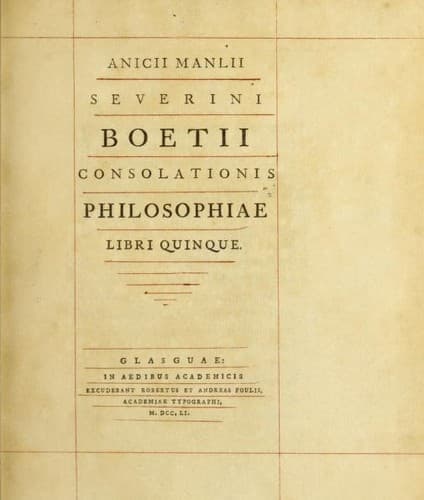
Chaucer's Translation of Boethius's "De Consolatione Philosophiae"Boethius
ReligionComparative
Chaucer's Translation of Boethius's "De Consolatione Philosophiae"
Boethius
Happiness; Philosophy and religion
[Sidenote: They are not to be reckoned precious because they are
counted amongst thy goods, but because they seemed so before thou
didst desire to possess them.]
¶ For-why
faire ne p{re}cioũs ne weren þei nat. for þat þei
comen amonges þi rycchesse. but for þei semeden fair
{and} p{re}cious. þerfore þou haddest leuer rekene hem 1260
amonges þi rycchesse.
[Sidenote: What, then, is it we so clamorously demand of Fortune?]
but what desirest þou of fortune
wiþ so greet a noyse {and} wiþ so greet a fare
[Sidenote: Is it to drive away indigence by abundance?]
¶ I
trowe þou seke to dryue awey nede wiþ habundaunce
of þinges.
[Sidenote: But the very reverse of this happens, for there is need
of many helps to keep a variety of valuable goods.]
¶ But certys it turneþ to ȝow al in þe 1264
contrarie. for whi certys it nediþ of ful many[e] helpynges
to kepen þe dyuersite of preciouse ostelmentȝ.
[Sidenote: They want most things who have the most.]
and soþe it is þat of many[e] þinges han þei nede þat
many[e] þinges han.
[Sidenote: They want the fewest who measure their abundance by the
necessities of nature, and not by the superfluity of their
desires.]
{and} aȝeyneward of litel nediþ 1268
hem þat mesuren hir fille after þe nede of kynde {and}
nat after þe outrage of couetyse
[Sidenote: Is there no good planted within ourselves, that we are
obliged to go abroad to seek it?]
¶ Is it þan so þat ye
men ne han no p{ro}pre goode. I-set in ȝow. For
whiche ȝe moten seken outwardes ȝoure goodes in 1272
foreine {and} subgit þinges.
[Sidenote: Are things so changed and inverted, that god-like man
should think that he has no other worth but what he derives from
the possession of inanimate objects?]
¶ So is þan þe condic{i}ou{n}
of þinges turned vpso dou{n}. þat a man þat is a devyne
beest by merit of hys resou{n}. þinkeþ þat hy{m}
self nys neyþer fair ne noble. but if it be þoruȝ 1276
possessiou{n} of ostelmentes. þat ne han no soules.
[Linenotes:
1255 _fair_--fayr{e}
_hire owen_--hyr owne
1256 _sholde_--sholden
_self_--selue
1257 _þin rycchesse_--thyne rychesses
1259 _amonges_--among{e}
1259, 1261 _rycchesse_--Rychesses
1259 _fair_--fayr{e}
1260 _leuer rekene_--leu{er}e rekne
1262 _greet_ (2)--grete
1265, 1267 _many[e]_--manye
1267 _soþe_--soth
1272 _outwardes_--owtward
1276 _fair_--fayr{e}
_if_--yif]
[Headnote:
IGNORANCE CRIMINAL IN MAN.]
[Sidenote: Inferior things are satisfied with their own
endowments, while man (the image of God) seeks to adorn his nature
with things infinitely below him, not understanding how much he
dishonours his Maker.]
Public-domain text, read in full here on John Shaqi.
Reviews
Reviews
No reviews yet
Be the first to share your thoughts on this work.
Elsewhere in the archive
Join the Discussion
Join the discussion
Sign in to leave a comment or review.
Sign InorCreate an account