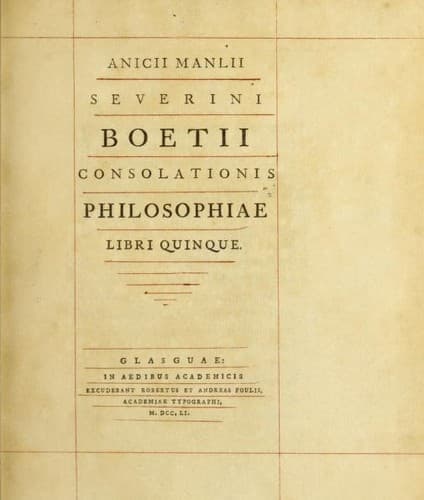
Chaucer's Translation of Boethius's "De Consolatione Philosophiae"Boethius
ReligionComparative
Chaucer's Translation of Boethius's "De Consolatione Philosophiae"
Boethius
Happiness; Philosophy and religion
¶ And certys al oþ{er} þi{n}ges ben appaied of hire owen
beautes. but ȝe men þat ben semblable to god by ȝour{e}
resonable þouȝt desiren to apparaille ȝour{e} excellent 1280
kynde of þe lowest[e] pinges. ne ȝe ne vndirstonde nat
how gret a wro{n}g ȝe don to ȝoure creato{ur}.
[Sidenote: God intended man to excel all earthly creatures, yet
you debase your dignity and prerogative below the lowest beings.]
for he
wolde þat man kynde were moost worþi {and} noble of
any oþer erþely þinges. and ȝe þresten adou{n} ȝoure [[pg 49]]
dignitees by-neþen þe lowest[e] þinges.
[Sidenote: In placing your happiness in despicable trifles, you
acknowledge yourselves of less value than these trifles, and well
do you merit to be so esteemed.]
¶ For if þat al 1285
þe good of euery þing be more p{re}ciouse þan is þilk
þing whos þat þe good is. syn ȝe demen þat þe
foulest[e] þinges ben ȝoure goodes. þanne summytten 1288
ȝe {and} putten ȝoure self vndir þo foulest[e] þinges by
ȝoure estimac{i}ou{n}. ¶ And certis þis bitidiþ nat wiþ
out ȝour{e} desert.
[Sidenote: Man only excels other creatures when he knows himself.]
For certys swiche is þe co{n}dic{i}ou{n}
of al man kynde þat oonly whan it haþ knowyng of it 1292
self. þan passeþ it i{n} noblesse alle oþer þinges.
[Sidenote: When he ceases to do so, he sinks below beasts.]
and whan it forletiþ þe knowyng of it self. þan it is
brouȝt byneþen alle beestes.
[Sidenote: Ignorance is natural to beasts, but in men it is
unnatural and criminal.]
¶ For-why alle oþer
[leuynge] beestes han of kynde to knowe not hem 1296
self. but whan þat men leten þe knowyng of hem self.
it comeþ hem of vice.
[Sidenote: How weak an error is it to believe that anything
foreign to your nature can be an ornament to it.]
but how brode sheweþ þe erro{ur}
{and} þe folie of ȝow men þat wenen þat ony þing may
ben apparailled wiþ straunge apparaillementȝ ¶ but 1300
for-soþe þat may nat be don.
[Sidenote: If a thing appear beautiful on account of its external
embellishments, we admire and praise those embellishments alone.]
for yif a wyȝt shyneþ wiþ
þi{n}ges þat ben put to hym. as þus. yif þilke þinges
shynen wiþ whiche a man is apparailled. ¶ Certis
þilke þinges ben commendid {and} p{re}ised wiþ whiche 1304
he is apparailled.
[Sidenote: The thing covered still continues in its natural
impurity.]
¶ But naþeles þe þing þat is
couered {and} wrapped vndir þat dwelleþ in his filþe.
[Sidenote: I deny that to be a good which is hurtful to its
owner.]
and I denye þat þilke þing be good þat anoyeþ hym
þat haþ it.
[Sidenote: Am I deceived in this? You will say no; for riches have
often hurt their possessors.]
Public-domain text, read in full here on John Shaqi.
Reviews
Reviews
No reviews yet
Be the first to share your thoughts on this work.
Elsewhere in the archive
Join the Discussion
Join the discussion
Sign in to leave a comment or review.
Sign InorCreate an account