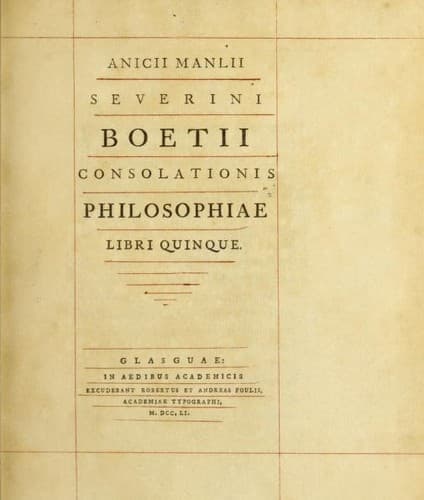
Chaucer's Translation of Boethius's "De Consolatione Philosophiae"Boethius
ReligionComparative
Chaucer's Translation of Boethius's "De Consolatione Philosophiae"
Boethius
Happiness; Philosophy and religion
¶ Certys ye remembriþ wel
as I trowe þat þilke dignitee þat men clepiþ þe emperie
of {con}sulers þe whiche þat somtyme was bygynnyng 1364
of fredom. ¶ Ȝoure eldres coueiteden to han
don a-wey þat dignitee for þe p{r}ide of þe conseilers.
[Linenotes:
1355 _seyne_--seye
1358 _come_--comen
1359 _don_--MS. done, C. don
_[as] greet[e]_--as grete
1360 _distruccioun_--destrucciou{n}s
_doþ_--MS. doþe, C. doth
_flamme_--flaumbe
1361 _flamme_--flawmbe
_wit_--omitted
1362 _doþ_--MS. doþe, C. doth
1363 _clepiþ_--clepyn
1364 _whiche_--whych
_somtyme_--whilom
1366 _for_--MS. of, C. for]
[[pg 52]]
[Headnote:
HONOURS NOT INTRINSICALLY GOOD,]
¶ And ryȝt for þe same p{r}ide ȝoure eldres byforne þat
tyme hadden don awey out of þe Citee of rome þe 1368
kynges name. þat is to seien. þei nolden haue no
lenger no kyng ¶ But now yif so be þ{a}t dignitees
{and} powers ben ȝeuen to goode men. þe whiche þing
is ful ȝelde. what agreable þi{n}ges is þer in þo dignitees. 1372
or powers. but only þe goodenes of folk þat vsen hem.
[Linenotes:
1368 _don_--MS. done, C. don
1369 _seien_--seyn
1370 _lenger_--lenger{e}
_kyng_--kynge
1371 _whiche_--which
1373 _folk_--foolkys]
[Headnote:
FOR THEY FALL TO THE LOT OF THE WICKED.]
[Sidenote: Virtue is not embellished by dignities, but dignities
derive honour from virtue.]
¶ And þerfore it is þus þat hono{ur} ne comeþ nat to
vertue for cause of dignite. but aȝeinward. hono{ur}
comeþ to dignite by cause of vertue.
[Sidenote: But what is this power, so much celebrated and
desired?]
but whiche is 1376
ȝoure derworþe power þat is so clere {and} so requerable
[Sidenote: What are they over whom you exercise authority?]
¶ O ȝe erþelyche bestes considere ȝe nat ouer whiche
þing þat it semeþ þat ȝe han power.
[Sidenote: If thou sawest a mouse assuming command over other
mice, wouldst thou not almost burst with laughter?]
[Sidenote: [* fol. 13 _b_.]]
¶ Now yif þou
say[e] a mouse amo{n}g{us} *oþer myse þat chalenged[e] to 1380
hymself ward ryȝt {and} power ouer alle oþer myse. how
gret scorne woldest þou han of hit. ¶ _Glosa._ ¶ So
fareþ it by men. þe body haþ power ouer þe body.
[Sidenote: What is more feeble than man, to whom the bite of a fly
may be the cause of death?]
For yif þow loke wel vpon þe body of a wyȝt what 1384
þing shalt þou fynde moore frele þan is mannes kynde.
þe whiche ben ful ofte slayn wiþ bytynge of smale
flies. or ellys wiþ þe entryng of crepyng wormes in to
þe priuetees of mennes bodyes.
Public-domain text, read in full here on John Shaqi.
Reviews
Reviews
No reviews yet
Be the first to share your thoughts on this work.
Elsewhere in the archive
Join the Discussion
Join the discussion
Sign in to leave a comment or review.
Sign InorCreate an account