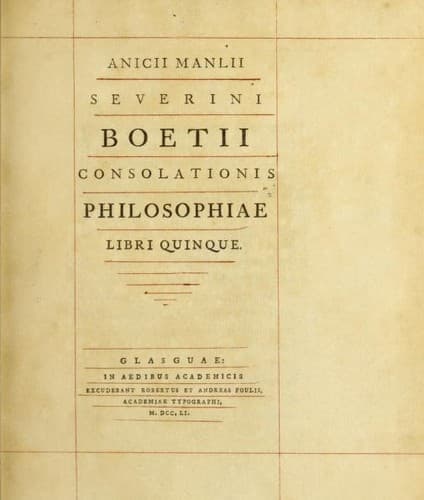
Chaucer's Translation of Boethius's "De Consolatione Philosophiae"Boethius
ReligionComparative
Chaucer's Translation of Boethius's "De Consolatione Philosophiae"
Boethius
Happiness; Philosophy and religion
[Sidenote: But how can any man obtain dominion over another,
unless it be over his body, or, what is inferior to his
body,--over his possessions, the gifts of Fortune?]
¶ But wher shal 1388
men fynden any man þat may exercen or haunten any
ryȝt vpon an oþer ma{n} but oonly vpon hys body. or
ellys vpo{n} þinges þat ben lower þen þe body. whiche
I clepe fortunous possessiou{n}s
[Sidenote: Can you ever command a freeborn soul?]
¶ Mayst þou euer haue 1392
any comaundement ouer a fre corage
[Sidenote: Can you disturb a soul consistent with itself, and knit
together by the bond of reason?]
¶ Mayst þou
remuen fro þe estat of hys p{ro}pre reste. a þouȝt þat is
cleuyng to gider in hym self by stedfast resou{n}. ¶ As
somtyme a tiraunt wende to co{n}founde a freeman of 1396
corage ¶ {And} wende to co{n}streyne hym by to{ur}ment [[pg 53]]
to maken hym dyscoueren {and} acusen folk þat wisten
of a coniurac{i}ou{n}. whiche I clepe a confederacie þat
was cast aȝeins þis tyraunt
[Sidenote: Have you not read how Anaxarchus bit off his tongue and
spat it in the face of Nicocreon?]
¶ But þis free man boot 1400
of hys owen tunge. {and} cast it in þe visage of þilke
woode tyrau{n}te. ¶ So þat þe to{ur}mentȝ þat þis
tyrau{n}t wende to han maked mater{e} of cruelte. þis
wyse man maked[e it] matere of vertues.
[Sidenote: What is it that one man can do to another that does not
admit of retaliation?]
¶ But what 1404
þing is it þat a man may don to an oþer man. þat he
ne may receyue þe same þing of oþer folke i{n} hym
self. or þus. ¶ What may a man don to folk. þat folk
ne may don hym þe same.
[Sidenote: Busiris used to kill his guests, but at last himself
was killed by Hercules, his guest.]
¶ I haue herd told of 1408
busirides þat was wo{n}t to sleen hys gestes þat herburghden
in hys hous. and he was slayn hym self of
ercules þat was hys gest
[Sidenote: Regulus put his Carthaginian prisoners in chains, but
was afterwards obliged to submit to the fetters of his enemies.]
¶ Regulus had[de] taken in
bataile many men of affrike. and cast hem in to fetteres. 1412
but sone after he most[e] ȝiue hys handes to
ben bounden w{i}t{h} þe cheynes of hem þat he had[de]
somtyme ou{er}comen.
[Sidenote: Is he mighty that dares not inflict what he would upon
another for fear of a requital?]
¶ Wenest þou þan þat he be
myȝty. þat may nat don a þing. þat oþer ne may don 1416
hym. þat he doþ to oþer.
[Sidenote: If powers and honours were intrinsically good, they
would never be attained by the wicked.]
Public-domain text, read in full here on John Shaqi.
Reviews
Reviews
No reviews yet
Be the first to share your thoughts on this work.
Elsewhere in the archive
Join the Discussion
Join the discussion
Sign in to leave a comment or review.
Sign InorCreate an account