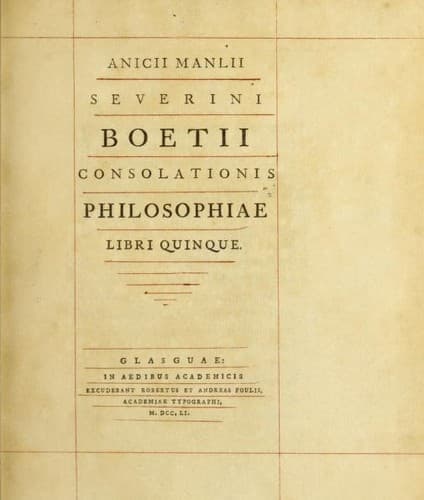
Chaucer's Translation of Boethius's "De Consolatione Philosophiae"Boethius
ReligionComparative
Chaucer's Translation of Boethius's "De Consolatione Philosophiae"
Boethius
Happiness; Philosophy and religion
{and} ȝe þan þat ben environed {and} closed wiþ
i{n}ne þe leest[e] prikke of þilk prikke þenke ȝe to
manifesten ȝoure renou{n} {and} don ȝoure name to ben
born forþe.
[Sidenote: What is there great in a glory so circumscribed?]
but ȝour{e} glorie þat is so narwe {and} so 1520
streyt yþronge{n} in to so litel boundes. how myche
conteinþe it in largesse {and} in greet doynge.
[Sidenote: Even in this contracted circle, there is a great
variety of nations, to whom not only the fame of particular men,
but even of great cities, cannot extend.]
And also
sette þis þer to þat many a nac{i}ou{n} dyuerse of tonge
{and} of maneres. {and} eke of resou{n} of hir lyuyng ben 1524
enhabitid in þe cloos of þilke litel habitacle. ¶ To þe
whiche nac{i}ou{n}s what for difficulte of weyes. {and} what
for diu{er}site of langages. {and} what for defaute of
vnusage entercomunynge of marchau{n}dise. nat only þe 1528
names of singler men ne may [nat] strecchen. but eke
þe fame of Citees ne may nat strecchen.
[Sidenote: In the time of Marcus Tullius the fame of Rome did not
reach beyond Mount Caucasus.]
¶ At þe
last[e] Certis in þe tyme of Marcus tulyus as hym
self writeþ in his book þat þe renou{n} of þe comune of 1532
Rome ne hadde nat ȝitte passed ne clou{m}ben ou{er} þe
mou{n}taigne þat hyȝt Caucasus. {and} ȝitte was þilk
tyme rome wel wexen {and} gretly redouted of þe p{ar}thes.
and eke of oþer folk enhabityng aboute.
[Sidenote: How narrow, then, is that glory which you labour to
propagate.]
¶ Sest þou 1536
nat þan how streit {and} how comp{re}ssed is þilke glorie
þat ȝe t{ra}uaile{n} aboute to shew {and} to multiplie.
[Sidenote: Shall the glory of a Roman citizen reach those places
where the name even of Rome was never heard?]
May þan þe glorie of a singlere Romeyne strecchen þider
as þe fame of þe name of Rome may nat clymben ne 1540
passen.
[Sidenote: Customs and institutions differ in different
countries.]
¶ And eke sest þ{o}u nat þat þe maners of
diu{er}se folk {and} eke hir lawes ben discordau{n}t amonge
hem self.
[Sidenote: What is praise-worthy in one is blame-worthy in
another.]
so þ{a}t þilke þing þat so{m}men iugen worþi of
p{re}ysynge. oþer folk iugen þat it is worþi of torment. 1544
Public-domain text, read in full here on John Shaqi.
Reviews
Reviews
No reviews yet
Be the first to share your thoughts on this work.
Elsewhere in the archive
Join the Discussion
Join the discussion
Sign in to leave a comment or review.
Sign InorCreate an account