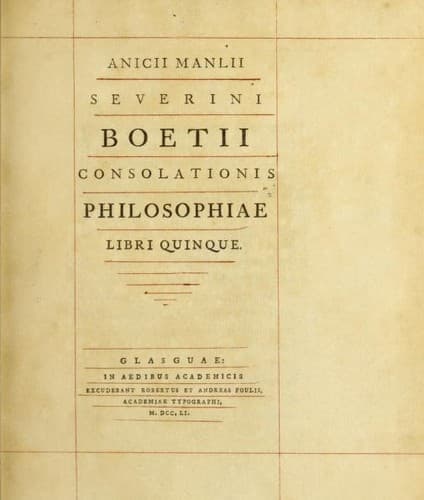
Chaucer's Translation of Boethius's "De Consolatione Philosophiae"Boethius
ReligionComparative
Chaucer's Translation of Boethius's "De Consolatione Philosophiae"
Boethius
Happiness; Philosophy and religion
somtyme þere was a man þat
had[de] assaied wiþ striuyng wordes an oþer ma{n}. ¶ þe
whiche nat for vsage of verrey vertue. but for proude 1584
veyne glorie had[de] take{n} vpon hym falsly þe name
of a philosopher. ¶ þis raþer man þat I speke of
þouȝt[e] he wolde assay[e] where he þilke were a
philosopher or no.
[Sidenote: [* fol. 15.]]
þat is to seyne yif he wolde han suffred 1588
lyȝtly in pacience þe wro{n}ges *þat weren don vnto hym.
[Sidenote: After counterfeiting patience for a while, the sophist
said to the other, ‘You must surely confess that I am a
philosopher.’]
¶ þis feined[e] philosophre took pacience a
litel while. {and} whan he hadde receiued wordes of
outerage he as in stryuynge aȝeine {and} reioysynge of 1592
hym self seide at þe last[e] ryȝt þus. ¶ vndirstondest
þou nat þat I am a philosophere.
[Sidenote: ‘I might have believed it,’ said the other, ‘had you
held your tongue.’]
þat oþer man answered[e]
aȝein ful bityngly {and} seide. ¶ I had[de]
wel vndirstonden [yt]. yif þou haddest holde{n} þi tonge 1596
stille.
[Sidenote: What advantage is it to great and worthy men to be
extolled after death?]
¶ But what is it to þise noble worþi men.
For certys of swyche folk speke .I. þat seken glorie wiþ
vertue. what is it q{uo}d she. what atteiniþ fame to
swiche folk whan þe body is resolued by þe deeþ. atte 1600
þe last[e].
[Sidenote: If body and soul die, then there can be no glory; nor
can there be when he (to whom it is ascribed) does not exist.]
¶ For yif so be þat men dien in al. þat is
to seyne body {and} soule. þe whiche þing oure resou{n}
defendiþ vs to byleuen þanne is þere no glorie in no
wyse. For what sholde þilke glorie ben. for he of 1604
who{m} þis glorie is seid to be nis ryȝt nouȝt in no wise.
[Sidenote: But if the soul is immortal when it leaves the body, it
takes no thought of the joys of this world.]
and ȝif þe soule whiche þat haþ in it self science of
goode werkes vnbounden fro þe p{r}isou{n} of þe erþe [[pg 60]]
wendeþ frely to þe heuene. dispiseþ it nouȝt þan alle 1608
erþely occupac{i}ou{n}s. {and} beynge i{n} heuene reioiseþ þat
it is exempt from alle erþely þinges [as wo seith /
thanne rekketh the sowle of no glorye of renou{n} of this
world]. 1612
Public-domain text, read in full here on John Shaqi.
Reviews
Reviews
No reviews yet
Be the first to share your thoughts on this work.
Elsewhere in the archive
Join the Discussion
Join the discussion
Sign in to leave a comment or review.
Sign InorCreate an account