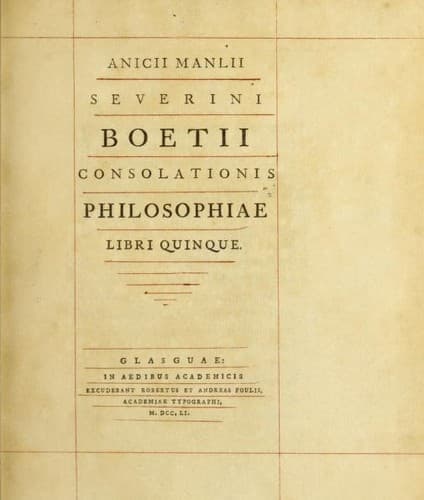
Chaucer's Translation of Boethius's "De Consolatione Philosophiae"Boethius
ReligionComparative
Chaucer's Translation of Boethius's "De Consolatione Philosophiae"
Boethius
Happiness; Philosophy and religion
[Sidenote: _P._ When I perceived that, silent and attentive, you
received my words, I expected to find such a state of mind in you,
or rather, I created in you such an one.]
than seyde she thus // þ{a}t feelede .I. ful wel q{uod} she //
whan þ{a}t thow ententyf {and} stylle rauysshedest my
wordes // {and} .I. abood til þ{a}t thow haddest swych habyte 1716
of thy thowght as thow hast now // or elles tyl þ{a}t .I.
my self had[de] maked to the the same habyt / which
þ{a}t is a moore verray thing{e} //
[Sidenote: What remains to be said is of such a nature that when
it is first tasted it is pungent and unpleasant, but when once
swallowed it turns sweet, and is grateful to the stomach.]
And certes the remenau{n}t
of thinges þ{a}t ben yit to seye / ben swyche // þ{a}t fyrst 1720
whan men tasten hem they ben bytynge / but whan
they ben resseyuyd w{i}t{h}-inne a whyht than ben they
swete //
[Sidenote: But because you say you would now gladly hear, with
what desire would you burn if you could imagine whither I am going
to lead you?]
but for thow seyst þ{a}t thow art so desirous to
herkne hem // wit[h] how gret brennynge woldesthow 1724
glowen / yif thow wystest whyder .I. wol leden the //
[Sidenote: _B._ Whither is that, I pray?]
whydyr{e} is þ{a}t q{uod} .I. //
[Sidenote: _P._ To that true felicity, of which you seem to have
but a faint foretaste.]
to thilke verray welefulnesse
q{uod} she // of whyche thynge herte dremeth //
[Sidenote: But your sight is clouded with false forms, so that it
cannot yet behold this same felicity.]
but for as moche as thy syhte is ocupied {and} distorbed / by 1728
Imagynasyon of herthely thynges / thow mayst nat yit
sen thilke selue welefulnesse //
[Sidenote: _B._ Show me, I pray, that true happiness without
delay.]
do q{uod} .I. {and} shewe
me / what is thilke verray welefulnesse / .I. preye the [[pg 64]]
w{i}t{h}-howte tarynge //
[Sidenote: _P._ I will gladly do so at your desire, but I will
first describe that false cause (of happiness), so that you may be
better able to comprehend the exact model.]
þ{a}t wole .I. gladly don q{uod} she / 1732
for the cause of the // but .I. wol fyrst marken the by
wordes / {and} I wol enforcen me to enformen the //
thilke false cause of blysfulnesse þ{a}t thow more knowest /
so þ{a}t whan thow hast fully by-holden thilke false 1736
goodes {and} torned thyne eyen to þ{a}t oother syde / thow
mowe knowe the clernesse of verray blysfulnesse //]
[Linenotes:
1702 _streyhte_--H. strenghed
1712 _am nat_--H. nam nought
1718 _had[de]_--H. hade
1734 _wol_--H. shall{e}
1739 _wil_--wole
_felde_--feeld]
[Headnote:
AWAY WITH FALSE FELICITY!]
[Sidenote: * Here the Add. MS. begins again.]
Public-domain text, read in full here on John Shaqi.
Reviews
Reviews
No reviews yet
Be the first to share your thoughts on this work.
Elsewhere in the archive
Join the Discussion
Join the discussion
Sign in to leave a comment or review.
Sign InorCreate an account