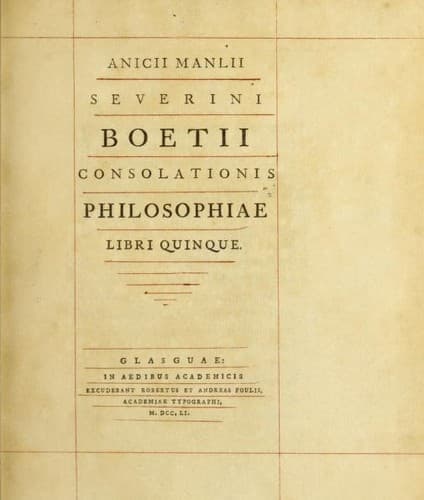
Chaucer's Translation of Boethius's "De Consolatione Philosophiae"Boethius
ReligionComparative
Chaucer's Translation of Boethius's "De Consolatione Philosophiae"
Boethius
Happiness; Philosophy and religion
[And blysfulnesse] is swiche a goode
þat who so haþ geten it he ne may ouer þat no þing more
desiire.
[Sidenote: It is the sovereign good, and comprehends all others.
It lacks nothing, otherwise it could not be the supreme good.]
and þis þing for soþe is þe souereyne good þat conteiniþ
in hym self al man{er}e goodes. to þe whiche goode 1760
yif þere failed[e] any þing. it myȝt[e] nat ben souereyne
goode. ¶ For þan were þere som goode out of þis ilke souereyne
goode þ{a}t myȝt[e] ben desired.
[Sidenote: Happiness is, therefore, that perfect state, in which
all other goods meet and centre.]
Now is it clere {and}
certeyne þa{n} þat blisfulnesse is a p{er}fit estat
by þe congregac{i}ou{n} 1764
of alle goodes.
[Sidenote: It is the object which all men strive after.]
¶ þe whiche blisfulnesse as
I haue seid alle mortal folke enforcen hem to geten by
dyuerse weyes.
[Sidenote: A desire of the true good is a natural instinct, but
error misleads them to pursue false joys.]
¶ For-whi þe couetise of verray goode
is naturely y-plaunted in þe hertys of men. ¶ But þe 1768
myswandryng erro{ur} myslediþ hem in to fals[e] goodes.
[Sidenote: Some, imagining the supreme good to consist in lacking
nothing, labour for an abundance of _riches_; others, supposing
that this good lies in the _reverence_ and _esteem_ of their
fellow men, strive to acquire honourable positions.]
¶ of þe whiche men some of hem wenen þat souereygne
goode is to lyue wiþ outen nede of any þing.
{and} t{ra}ueile{n} hem to ben habundaunt of rycchesse. 1772
and some oþer men deme{n}. þat sou{er}ein goode be forto
be ryȝt digne of reu{er}ences. {and} enforce{n} hem to ben
reu{er}enced among hir neyȝbo{ur}s. by þe hono{ur}s þat þei
han ygeten
[Sidenote: There are some, again, who place it in supreme _power_,
and seek to rule, or to be favoured by the ruling powers.]
¶ {and} some folk þer ben þat halden þat 1776
ryȝt heyȝe power to be souereyn goode. {and} enforcen
he{m} forto regnen or ellys to ioigne{n} he{m} to hem þat
regnen.
[Sidenote: There are those who fancy _fame_ to be the height of
happiness, and seek by the arts of war or peace to get renown.]
¶ And it semeþ to some oþer folk þat noblesse
of renou{n} be þe sou{er}ein goode. {and} hasten hem to 1780
geten glorious name by þe artes of werre or of pees.
[Sidenote: Many there are who believe nothing to be better than
_joy_ and _gladness_, and think it delightful to plunge into
luxury.]
and many folke mesuren {and} gessen þ{a}t sou{er}ein goode
be ioye {and} gladnesse {and} wenen þat it be ryȝt blisful
[thyng{e}] to ploungen hem i{n} uoluptuous delit.
Public-domain text, read in full here on John Shaqi.
Reviews
Reviews
No reviews yet
Be the first to share your thoughts on this work.
Elsewhere in the archive
Join the Discussion
Join the discussion
Sign in to leave a comment or review.
Sign InorCreate an account