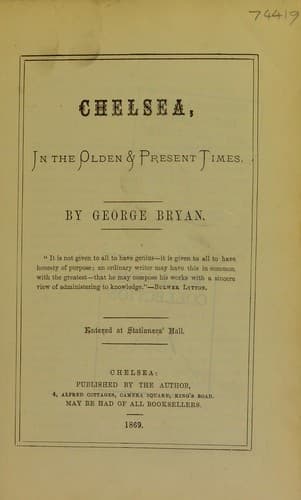
Chelsea, in the Olden & Present TimesBryan, George
History
Chelsea, in the Olden & Present Times
Bryan, George
Chelsea (London, England) -- History
It may here be mentioned that the “watchhouse,” and the “stocks” for
vagrants, formerly stood close to the river, opposite the church.
History of the Manor.
ROYAL AND DISTINGUISHED RESIDENTS.
BLACKSTONE, in his “Commentaries,” says that manors are, in substance, as
ancient as the Saxon Constitution. The manor of Chilchell, or Chelcheya
(Chelsea), was given it appears, in the reign of Edward the Confessor to
the Abbot and Convent of Westminster, by Thurstan, the governor of the
king’s palace, who held it of him. This gift was confirmed by a charter,
which transfers the manor, with all its rights and appurtenances, as
fully as it was held by Thurstan: “besides, together with this manor, as
a free gift, every third tree, and every third horse load of fruits grown
in the neighbouring wood at Kyngesbyrig” (now called Knightsbridge).
This charter, which is in the Saxon language, is still preserved in the
British Museum. It is sealed with a waxen seal, suspended by a silken
string, after the Norman fashion, in the front of which are the effigies
of the king, holding in his right hand a cross, and in his left a globe;
on the reverse is the same image, holding in his right hand a spear
surmounted by a dove, and bearing in his left a sword, with this
inscription on both sides, “The seal of Edward King of England.”
King William, by a charter dated at Westminster, confirmed the land to
the Monastery of Westminster.
The Record of Domesday Book, to which we are so greatly indebted, was
begun in 1080, and completed in 1086. In it is mentioned the lands in
Chelsea, then in possession of the Church of Westminster.
The general description given of menial persons, including those in the
manor of Chelsea, at the period when the survey of the land belonging to
the lords, or great landowners, was taken, shows the lamentable state of
thousands of our fellow-creatures. Slaves were allowed nothing but
subsistence and clothes, and were distinguished from freemen by a
peculiar dress. Long hair was a mark of dignity and freedom; for that
reason, slaves, (menial persons,) were obliged to shave their heads, by
which they were reminded of their inferiority of condition. At length
Henry VIII. granted manumission to two of his slaves and their families,
for which he assigned this just reason: “God at first created all men
equally free by nature, but many had been reduced to slavery by the laws
of men. We believe it, therefore, to be a pious act, and meritorious in
the sight of God, to set certain of our slaves at liberty from their
bondage.” The granting of leases, which afterwards followed, almost
completely emancipated the “villain-slave,” so that at the time of
Elizabeth, scarcely any person existed to whom the former laws applied.
Gervace, abbot of Westminster, aliened the manor of Chelchithe, to his
mother Dameta and her heirs. Afterwards it was held by the heirs of
Bartholomew de Fontibus.
Public-domain text, read in full here on John Shaqi.
Reviews
Reviews
No reviews yet
Be the first to share your thoughts on this work.
Join the Discussion
Join the discussion
Sign in to leave a comment or review.
Sign InorCreate an account