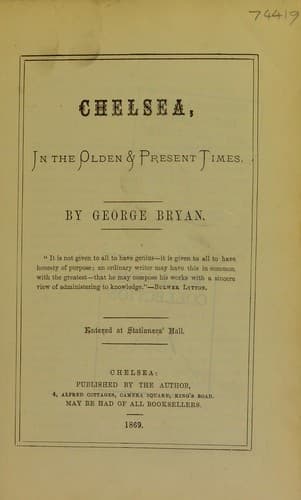
Chelsea, in the Olden & Present TimesBryan, George
History
Chelsea, in the Olden & Present Times
Bryan, George
Chelsea (London, England) -- History
Several court rolls of this manor, during the reigns of King Edward III.
and Richard II. are among the records of the Dean and Chapter of
Westminster.
A brewer, of the name of North, was presented at one of these courts for
not putting up a sign as was customary; and at another the wife of Philip
Rose was fined 6_d._ for being a common babbler.
Simon Bayle appears to have been lessee of the manor house, 33 Hen. VI.,
and from that period there is a total deficiency of records till the
reign of Henry VII.
* * * * *
Sir Reginald Bray was now in possession of the manor. He was Receiver
General to Sir Henry Stafford, a younger son of the Duke of Buckingham,
who married the widow of the Earl of Richmond, and mother of Henry VII.
There are many interesting historical particulars respecting Sir Reginald
Bray. He was buried in the chapel of St. George, Windsor.
* * * * *
From Sir Reginald Bray the manor descended to Margaret, only child of his
next brother, John, who married Sir William Sandys, created afterwards
Lord Sands. He was one of those peers who subscribed the articles
exhibited to Henry VIII. against Cardinal Wolsey; and the next year was
also one who signed the declaration to the Pope, intimating the danger of
losing his supremacy, in case he did not comply with the king’s wishes in
regard to his divorce from Queen Catherine. He died in 1542.
There have been various surmises as to the correct definition of “Sands
End,” in Fulham parish, which immediately adjoins Chelsea, and is called
such for a short distance. I venture to suggest the following
explanation. Lord Sands, being Lord of the Manor of Chelsea, his rights
terminated at the spot just mentioned, and to record this fact the people
of Fulham called it Sands End, signifying thereby that Lord Sands’s
jurisdiction and property ended there. Perhaps this idea is not
original, but I have never heard it thus explained, and therefore I have
given it.
This Lord Sands, a few years previous to his death, conveyed to Henry
VIII. the manor of Chelsea, with certain closes or land situated at
Kensal Green, near Wilsden, containing about 137¾ acres. {26} In 1861
there were in that part of Kensal which belongs to this parish 591 houses
and 3223 inhabitants. The number of houses has since increased, and the
present population may be estimated at 3500 persons. There are a great
many highly respectable residents, and a large number of superior new
houses are continually being erected in the adjoining wealthy parishes,
which will ultimately increase the trade and value of property in the
entire district. There are also several new Churches and Chapels built
within the last few years in the neighbourhood. The Paddington Canal,
which passes through the detached parts of Chelsea and Kensington, was
opened with an aquatic procession on the 10th of July, 1801, in the
presence of a vast concourse of spectators.
Public-domain text, read in full here on John Shaqi.
Reviews
Reviews
No reviews yet
Be the first to share your thoughts on this work.
Join the Discussion
Join the discussion
Sign in to leave a comment or review.
Sign InorCreate an account