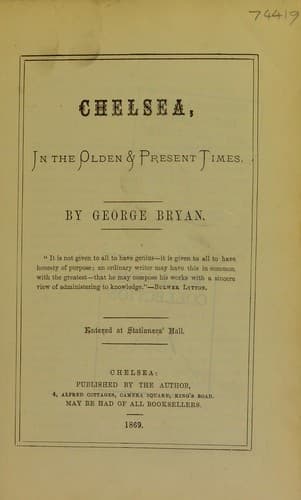
Chelsea, in the Olden & Present TimesBryan, George
History
Chelsea, in the Olden & Present Times
Bryan, George
Chelsea (London, England) -- History
Sir Hans Sloane, Bart., purchased the manor of William Lord Cheyne, the
second and last Viscount Newhaven, in the year 1712. Sir Hans was
descended from a family originally of Scotland, but settled in the north
of Ireland, where he received his first education. At that early age he
evinced a very strong inclination to study the works of Nature, which he
pursued with uncommon application through the rest of his life. Being
desirous of improving himself in the several branches of physic, to the
profession of which he was ardently devoted, he came to London, and
resided in a house adjoining to the laboratory of Apothecaries’ Hall.
Here Mr. Sloane acquired a perfect knowledge of the preparations and uses
of most chemical medicines; and at the same time prosecuted his favourite
science of botany in the Apothecaries’ Gardens at Chelsea. He ultimately
became President of the Royal College of Physicians, London, and
associated and corresponded with most of the eminent men of his day. He
had been previously Secretary to the Royal Society, which he held for 20
years without any salary, and was the intimate friend of Sir Isaac
Newton. In the last sickness of Queen Anne he was called in to her
assistance, as one of her physicians, as he had been on some former
occasions. He was created a baronet by George I., an honour which had
never before been conferred upon any physician in England. Upon
purchasing the manor of Chelsea, he gave a portion of the ground of his
garden to the Apothecaries’ Company, in order to perpetuate it for the
improvement of botanical knowledge, and to communicate to others that
instruction which he had himself received there. Besides the donation of
so large and valuable a piece of ground, in a delightful situation on the
banks of the Thames, and near the metropolis, he contributed largely
towards building the stairs at the water-side gate, and an additional sum
towards the expenses of the garden. When Sir Isaac Newton died, Sir Hans
Sloane was chosen as President of the Royal Society, and continued in
that high office for fourteen successive years. His decay was very
gradual, and foretold that he would one day “drop like a fruit fully
ripe.” He died in 1753, and was interred in the churchyard of Chelsea,
in the same vault with his lady. His funeral was attended by many
persons of distinction, and several Fellows of the Royal Society. He has
been styled “the father of natural history in these realms.”
Public-domain text, read in full here on John Shaqi.
Reviews
Reviews
No reviews yet
Be the first to share your thoughts on this work.
Join the Discussion
Join the discussion
Sign in to leave a comment or review.
Sign InorCreate an account