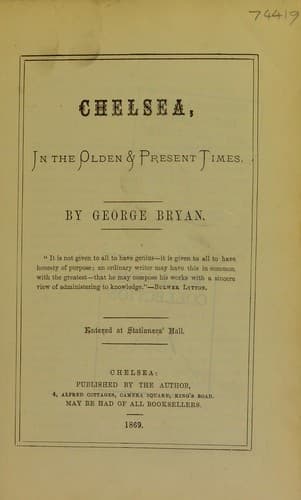
Chelsea, in the Olden & Present TimesBryan, George
History
Chelsea, in the Olden & Present Times
Bryan, George
Chelsea (London, England) -- History
Sir Hans Sloane’s invaluable Museum, sold to the nation at his decease
for £20,000, being about a fourth of its value, was the nucleus, and so
far the first foundation, of the British Museum. He bequeathed one
moiety of the manor of Chelsea to his daughter Sarah, the wife of George
Stanley, Esq., of Paultons, in Hampshire, and the remainder to his second
daughter, the lady of Charles Lord Cadogan, in which family the property
still remains. Hence the names of Cheyne Walk, Hans Place, Sloane
Street, Cadogan Place, Oakley Street, and Paultons Square. The eldest
son of Earl Cadogan takes his father’s second title, Viscount Chelsea.
Mrs. Stanley, daughter of Sir Hans Sloane, left one son and two
daughters; Hans Stanley, Esq., the son, who died in 1780, and bequeathed
to his sisters, Anne, the wife of W. Ellis, Esq., afterwards Lord Mendip,
and Sarah, the wife of Christopher D’Oyley, Esq., his moiety of this
manor, with the reversion to Lord Cadogan and his heirs.
Sir Thomas More’s House.
SIR THOMAS MORE purchased an estate at Chelsea, about the year 1520, and
built himself a house, as Erasmus describes it, “neither mean nor subject
to envy, yet magnificent and commodious enough.” The site of this house
has been long disputed. The Rev. Dr. King, (who is noticed amongst the
rectors of the Old Church), in his “Letter designed for Mr. Hearne,”
relative to Sir Thomas More’s house, and which is in the British Museum,
says, “As seven cities in Greece contended for the birthplace of Homer,
so there are no fewer than four houses in this parish which lay claim to
Sir Thomas More’s residence, viz.: that which is now the Duke of
Beaufort’s; that which was lately Sir Joseph Alstone’s; that which was
once Sir Reginald Bray’s, and afterwards William Powell’s, which is now
built into several tenements; and that which was lately Sir John
Danvers’s, which is also now pulled down; and on part of the ground a
small street is built, called Danvers Street, and some other houses. Now
of all these, in my opinion, Beaufort House bids fairest to be the place
where Sir Thomas More’s stood.” He then proceeds to give his reasons for
arriving at this conclusion, which, when considered in connection with
the statements of other writers on the subject, clearly establishes the
correctness of Dr. King’s opinion. Sir Thomas More’s house, therefore,
we will conclude stood almost on the site of what is now called Beaufort
Street, facing Battersea Bridge. After his death, however, very
considerable alterations and additions were made by succeeding occupants,
both in regard to the house and grounds attached to it. The house, in
its altered state, was pulled down about 140 years ago.
* * * * *
Public-domain text, read in full here on John Shaqi.
Reviews
Reviews
No reviews yet
Be the first to share your thoughts on this work.
Join the Discussion
Join the discussion
Sign in to leave a comment or review.
Sign InorCreate an account