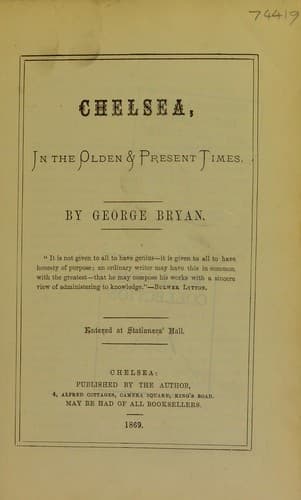
Chelsea, in the Olden & Present TimesBryan, George
History
Chelsea, in the Olden & Present Times
Bryan, George
Chelsea (London, England) -- History
George, the second Duke of Buckingham, soon after the Restoration,
recovered his father’s estates, and was the possessor of this house for a
few years, but was soon obliged to dispose of it for the benefit of his
creditors.
* * * * *
Dryden, in his poem of Absalom and Achitophel, has drawn the following
portrait of this nobleman in the character of Zimri:—
“A man so various, that he seemed to be
Not one, but all mankind’s epitome:
Stiff in opinions, always in the wrong,
He’s every thing by starts, and nothing long;
But in the course of one revolving moon,
Was Chymist, Fidler, Statesman, and Buffoon.
In squandering wealth, was his peculiar art,
Nothing went unrewarded but desert.
Beggar’d by fools, when still he found, too late
He had his jest, and they had his estate.”
James Plummer, one of the Duke of Buckingham’s principal creditors, was
the person in whose name this house was aliened in 1674, in trust, for
George, Earl of Bristol, who is said to have died at Chelsea, and to have
been buried in the church, but there is no memorial of him, or entry of
his interment in the Parish Register.
* * * * *
George Digby, Earl of Bristol, was born in 1612, and was educated at
Oxford; he soon became distinguished by his remarkable advancement in all
kinds of elegant literature. In the beginning of the Long Parliament he
was disaffected to the Court; shortly afterwards he appeared a declared
enemy to the Parliament; and having testified his dislike of their
proceedings against Lord Strafford, he was expelled the House of Commons
in 1641. Upon the death of the king his lordship was exempted from
pardon by the Parliament, and obliged to live in exile till the
restoration of Charles II., when he recovered all he had lost; he grew
very active in public affairs, spoke frequently in Parliament, and made
himself conspicuous for his enmity to Lord Clarendon. Lord Bristol died
in 1677, “neither loved nor regretted by any party.” The house at
Chelsea he bequeathed to his Countess, Lady Ann Russell, daughter of
Francis, Earl of Bedford, who sold it in 1682, to the Marquis of
Worcester, created Duke of Beaufort, and who died in 1699.
* * * * *
Public-domain text, read in full here on John Shaqi.
Reviews
Reviews
No reviews yet
Be the first to share your thoughts on this work.
Join the Discussion
Join the discussion
Sign in to leave a comment or review.
Sign InorCreate an account