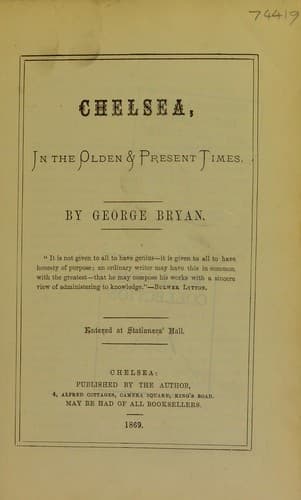
Chelsea, in the Olden & Present TimesBryan, George
History
Chelsea, in the Olden & Present Times
Bryan, George
Chelsea (London, England) -- History
George Villiers, first Duke of Buckingham, the son of Sir George
Villiers, was born in 1592. By the elegance of his person, and the
courtliness of his address, he gained as great an ascendance over King
James as the favourite of any other prince is known to have done by a
long course of assiduity and insinuation. The Earl of Clarendon says,
that the duke “was of a most flowing courtesy and affability to all men
who made any address to him, and so desirous to oblige them, that he did
not enough consider the value of the obligation, or the merit of the
person he chose to oblige; from which much of his misfortune resulted.”
He married Lady Catherine Manners, the daughter of Francis, Earl of
Rutland, by whom he had three sons and a daughter; he was assassinated at
Portsmouth in 1628, by one Felton. The eldest son, George, who succeeded
him in his title and estates, being very young at the time of his
father’s murder, was sent to travel during the civil wars; and returning
to England whilst Charles I. was under restraint, he and his brother,
Lord Francis Villiers, thought themselves obliged to venture their lives
and fortunes for the king at the first opportunity. Soon after, the
Parliament voted that he should be proceeded against as a traitor, and
that his estates should be sequestered.
* * * * *
Sir Thomas More’s house, for such it ought still to be considered,
notwithstanding the great alterations made in it, was now known as
Buckingham House, in consequence of its having been granted to the first
Duke of Buckingham. It appears by the following extract from a
periodical paper after that duke’s death, to have been in possession of
his daughter Mary, who married James, Duke of Richmond and Lenox: “The
Duchess of Lenox, daughter of the Duke of Buckingham, being then at
Oxford, petitioned the Lords for leave to come to London, or to her house
at Chelsey, to be under Dr. Mayerne’s hands for her health; a pass was
ordered for her, and the concurrence of the Commons desired.”
* * * * *
Buckingham House, in 1649, having been seized by the Parliament, was
committed to the custody of John Lisle, one of the Commissioners of the
Great Seal. This gentleman’s own estates were afterwards confiscated,
and he then retired to the continent. He was shot by some unknown person
as he was going to church at Lausanne. A short time after the house was
granted to Sir Bulstrode Whitlock, who resided with his family at Chelsea
for some years.
* * * * *
Sir Bulstrode Whitlock was the son of a Judge of the Court of King’s
Bench; he wrote a memorial of English affairs from the latter part of the
reign of Charles I. to the Restoration.
* * * * *
Public-domain text, read in full here on John Shaqi.
Reviews
Reviews
No reviews yet
Be the first to share your thoughts on this work.
Join the Discussion
Join the discussion
Sign in to leave a comment or review.
Sign InorCreate an account