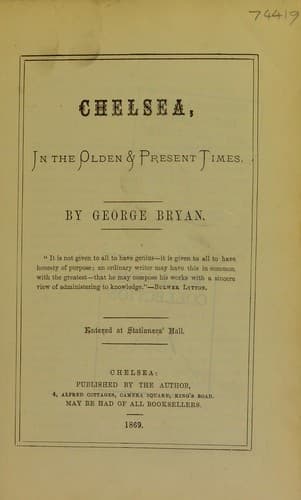
Chelsea, in the Olden & Present TimesBryan, George
History
Chelsea, in the Olden & Present Times
Bryan, George
Chelsea (London, England) -- History
The burial service of the church is particularly impressive. The coffin
being deposited in the middle of the chapel, a hymn is sung by the
congregation, for they value and carefully cultivate music as a science,
and the responses of their liturgies are attended with peculiar effect.
The Minister then delivers a discourse, in which some account is given of
the deceased, with suitable exhortations. The form of service contained
in their Liturgy is next read, and the congregation then follow the
corpse, the men walking together, and the women the same. A scriptural
passage is read, commencing as follows. “Meanwhile none of us liveth to
himself; for whether we live, we live unto the Lord, and whether we die,
we die unto the Lord,” &c. The following is then sung by the
congregation:—
“Now to the earth let these remains
In hope committed be,
Until the body, chang’d, obtains
Blest immortality.”
While the above verse is being sung the body is let down into the grave.
A prayer is then offered, and the whole is concluded by singing a verse
of another hymn.
* * * * *
The chapel at the north side of the burial ground occupies the site of
the old stables of Beaufort House. It is a plain building, displaying no
architectural adornments, and it is now upwards of fifty years since
Divine service was performed in it by the brethren. For a long time it
has been occupied as a schoolroom for the boys belonging to Park Chapel
National and Sunday Schools, and most of the annual meetings of the
numerous societies, which are supported by the congregation of Park
Chapel, are at present held in it.
* * * * *
The house adjoining the entrance to the Moravian Chapel and Burial
Ground, some few years since pulled down, was for many years in the
occupation of the Howard family, of the Society of Friends. The elder
Mr. Howard was gardener to Sir Hans Sloane; his brother having a natural
genius for mechanics, became a clockmaker, and made the clock in the Old
Church, in 1761, for the sum of £50. In the front of Howard’s house was
placed a large clock, and hence the origin of the appellation, “Clock
House,” as now applied to what was once the Moravian chapel.
LINDSEY ROW.
It was mentioned at the commencement of the description of Lindsey House,
that it had been divided into five houses, called Lindsey Row. These
houses still remain, and are inhabited at the present time by families of
great respectability. They command a most delightful prospect of the
Thames, which here forms a sort of bay; the view from the upper stories
is bounded on the south by the Surrey Hills, and Putney Heath on the
north.
* * * * *
Public-domain text, read in full here on John Shaqi.
Reviews
Reviews
No reviews yet
Be the first to share your thoughts on this work.
Join the Discussion
Join the discussion
Sign in to leave a comment or review.
Sign InorCreate an account