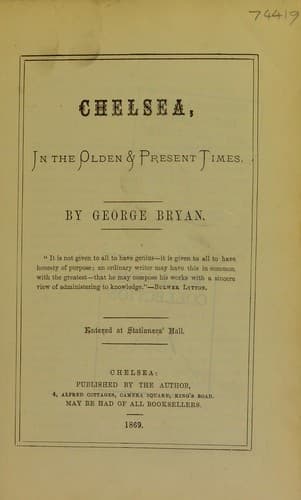
Chelsea, in the Olden & Present TimesBryan, George
History
Chelsea, in the Olden & Present Times
Bryan, George
Chelsea (London, England) -- History
Henry Constantine Jennings, Esq., a most eccentric and unfortunate
gentleman, resided in the first house on the east. He was born in 1731,
and was descended from a very ancient and illustrious family, the Nevils.
The celebrated Sarah, Duchess of Marlborough, he reckoned among his
progenitors. At an early age he obtained a commission in the first
regiment of Foot Guards, and afterwards went abroad on his travels.
While in Italy, he formed an acquaintance with the Duke of Marlborough,
then Marquis of Blandford, and it is said he suggested the idea of the
cabinet of antiques, afterwards engraved by Bartolozzi, and so well known
as the Marlborough Gems. It was at this period, doubtless, that Mr.
Jennings acquired a passion for objects of taste. On his return to
England, he repaired to his seat at Shiplake, in the county of Oxford,
and unfortunately for him became addicted to the pleasures of the turf,
and the result was that his fortune was soon dissipated. Mr. Jennings
now withdrew from society and lived in obscurity. A sudden change of
fortune seems, however, to have released him from pecuniary difficulties,
for we find him collecting, with great ardour, every object of antiquity,
&c., that was presented to his notice, and which he could purchase. He
also possessed a most valuable library. But, again, he became reduced in
his circumstances, and had to dispose of his books and collections at a
vast loss.
From this time but few particulars are known of Mr. Jennings, until he
settled at Lindsey Row, about 1792. Here he continued to reside, fully
occupied as an antiquary, a virtuoso, and an author, until, at length,
his health began to decline, and his fortune daily became deteriorated,
in consequence of his inordinate passion for collecting objects of taste;
at last he closed his eccentric career a prisoner within the rules of the
King’s Bench, where he expired February 7, 1819, aged 88.
This remarkable gentleman, whom I well remember, seemed more properly to
belong to some distant generation rather than the one in which he
lived—his character, dress, and manners, were so different in every
respect. The fate of such a man, to a certain extent, awakens our
sympathy, for his pursuits were generally throughout his life most
refined; and the disasters which befel him is a warning to many in the
present day.
* * * * *
Public-domain text, read in full here on John Shaqi.
Reviews
Reviews
No reviews yet
Be the first to share your thoughts on this work.
Join the Discussion
Join the discussion
Sign in to leave a comment or review.
Sign InorCreate an account