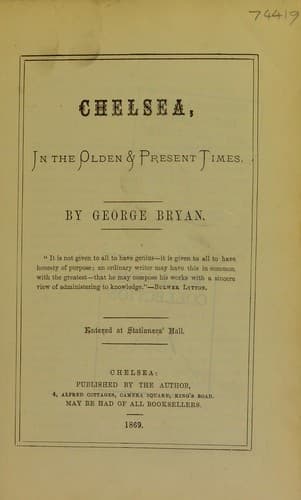
Chelsea, in the Olden & Present TimesBryan, George
History
Chelsea, in the Olden & Present Times
Bryan, George
Chelsea (London, England) -- History
The earliest mention of Chelsea is to be found in the Saxon Chronicle, in
the year 785; from which record it appears that a Synod was then held in
it, and at which period it was the residence of Offa, king of the
Mercians. As regards the etymology of its name both ancient and modern
writers have expressed different opinions. Mr. Lysons says, he has seen
it written Cealc-hylle, in an old charter of Edward the Confessor, and
hence objected to the obvious etymology, as there is neither chalk nor
hill in the parish. Mr. Faulkner considers, however, that “hylle” is an
evident mistake for “hythe;” and Cealc-hythe signifies not a place
abounding in chalk, but a wharf or landing-place for chalk brought from
other quarters. This amended definition seems at once to remove the
previous objection, particularly as large quantities of chalk and lime
were formerly, and even now at times, landed at a wharf by the river-side
at Chelsea. In the ancient record of Domesday, it is written Cherchede
and Chelched. The parish was called Chelchethe in the taxation of Pope
Nicholas, in 1291; and this was the common way of spelling it for several
centuries. Among the manorial records of the time of Edward II. it is
spelled Chelcheya and Chelchuthe. Mr. Norden says, “It is so called from
the nature of the place, whose strand is like the Chesel, (ceosel, or
cesel,) which the sea casteth up of sand and pebble stones, thereof
called Cheselsey, briefly Chelsey.” How altered is the state of the
strand or shore at the present time! Would that there were now only the
sand and pebble stones! But there is a probability that this complaint
will be remedied. The long expected embankment from Battersea Bridge to
Chelsea College, it is said, really _is_ to be commenced and completed,
and those old and dilapidated houses in that narrow and dangerous
thoroughfare, known as Duke Street and Lombard Street, are to be pulled
down. If this should be the case, the parishioners will then possess one
of the finest promenades, with Battersea Park opposite to it, which may
be found along the entire banks of the river Thames.
Having made this slight digression, to infuse a little of what is
popularly called “new life” into our subject, we will here mention that
the county of Middlesex received its name from having been inhabited by a
party of Saxons, who, being located in the midst of the three kingdoms of
the East, West, and South Saxons, were called by their neighbours
Middlesaxons, which, in common conversation, was soon abbreviated to
Middlesex.
Public-domain text, read in full here on John Shaqi.
Reviews
Reviews
No reviews yet
Be the first to share your thoughts on this work.
Join the Discussion
Join the discussion
Sign in to leave a comment or review.
Sign InorCreate an account