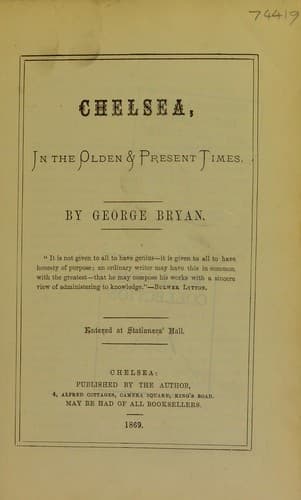
Chelsea, in the Olden & Present Times — John Shaqi
Chelsea, in the Olden & Present TimesBryan, George
History
Chelsea, in the Olden & Present Times
Bryan, George
Chelsea (London, England) -- History
The parish of Chelsea is bounded on the north by the Fulham Road, which
separates it from Kensington. On the east at the entrance into Sloane
Square, at which place there was an open rivulet, which divided it from
St. George’s, Hanover Square, and was said to rise at or near to
Hampstead; and, after crossing Hyde Park, where it formed the Serpentine
River, and Knightsbridge, flowed behind Cadogan Place (along a portion of
Lowndes’ Square) into the Thames, at Ranelagh, which adjoined Chelsea
College. In January, 1809, this rivulet overflowed its banks, and caused
great devastation for several days. The waters formed a complete lake,
and were of considerable depth. Boats were employed in carrying
passengers from Chelsea Hospital to the old Bunhouse, on their way to
London. On the west, the parish is divided from Fulham a little beyond
St. Mark’s College; and on the south it is bounded by the Thames.
That portion of the parish at Kensal New Town, which is near to Wilsden,
will be briefly noticed again in reference to the “Ancient Manor Houses.”
This land, as held by the parish, is about 173¾ acres.
The Old Parish Church.
IT will soon be seventy years since I was first taken to this venerable
Church. The most trifling incidents in childhood often bring to
remembrance, when arrived at mature age, events of an important and
interesting character. Such was the case with regard to my earliest
conscious attendance at Chelsea Old Church. At the period to which I
allude, residing at the other part of the parish, we had to go across
what was then called the “Common,” situated to the east of the present
new St. Luke’s Church, a portion of which was at that particular time
covered with new-mown grass to dry previously to being carried away.
Most young persons love to toss and tumble about the hay when such an
opportunity is afforded them, and certainly I felt as delighted with the
sport as others of my own age. Often afterwards, when there was a
disposition not to take me, I earnestly pleaded to go with the rest to
the Church, but my youthful thoughts were more fixed on some anticipated
enjoyment on the road to it. As I advanced in years, however, my native
Old Parish Church became gradually endeared to me, and nothing connected
with it scarcely ever escaped my notice.
The exact period when the Church was erected is a question of great
uncertainty. In the Domesday Survey of the Parish no mention is made of
any endowment for a priest, which is considered by some writers a proof
that there was no Church existing. This conclusion is doubtful. There
is no record relative to the Rectory previous to the reign of Edward II.,
therefore it is conjectured that the Church was first founded about that
period.
Public-domain text, read in full here on John Shaqi.
Reviews
Reviews
No reviews yet
Be the first to share your thoughts on this work.
Join the Discussion
Join the discussion
Sign in to leave a comment or review.
Sign InorCreate an account