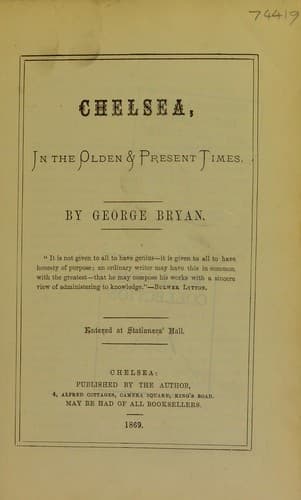
Chelsea, in the Olden & Present TimesBryan, George
History
Chelsea, in the Olden & Present Times
Bryan, George
Chelsea (London, England) -- History
SIR HENRY WRIGHT WILSON AND THE POOR CARPENTER.—The following anecdote
will no doubt amuse many readers. Sir Henry’s establishment was large,
and he had been accustomed to employ at times a jobbing carpenter, who
had at one period been in better circumstances. This person had received
specific instructions to do certain work, which required a little
trifling assistance, such as to help him to remove something which stood
in the way, and which the carpenter could not possibly do without
temporary aid. He asked several of the grooms and others to assist, but
they all made frivolous excuses, and consequently the work was not done
by the appointed time. When Sir Henry returned home he noticed that his
orders had been neglected, and, on ascertaining the particulars, without
making any remarks, he quietly entered the house. The next morning,
however, he gave instructions for his carriage with four horses to be
immediately got ready. He then sent for the carpenter, and after a short
time the carriage was at the entrance door, when, to the great surprise
of the servants, he desired him to take a seat in it. Sir Henry then
mounted his horse, and, notwithstanding the dirty state of the roads,
took them through Fulham, over Putney Bridge, round by Wandsworth and
Battersea, back to Chelsea. On their return he insisted that the horses
and carriage should be immediately cleaned, or else to be dismissed from
his service. Sir Henry being esteemed a good master they preferred
obedience, and it was said that although the carpenter was afterwards
subject to an occasional jeer, he never had again to complain of their
conduct towards him.
* * * * *
QUEEN’S ELM.—This is situated at the top of Upper Church Street, but the
spot for some time past seems to be merged into the Fulham Road, and is
either so called, or else it is described as being near to it. The
original name, Queen’s Elm, which it is to be hoped will still be
retained, is said traditionally to have derived its origin from the
following circumstance. Queen Elizabeth was walking out with the great
Lord Burleigh, and being overtaken with a heavy shower of rain, took
shelter under an elm tree growing on this spot. After the shower was
over, she said, “Let this henceforth be called the Queen’s Tree.” This
tradition is remarkably confirmed, as will be seen by the following
extract:—“It appears by the Church Book, beginning 1586, and in the 28th
Elizabeth, that the tree at the end of the Duke’s Walk is in Chelsea
parish called the Queen’s Tree; and that there was an arbour built round
it by one Bostocke, at the charge of the parish.”
The Jews’ Burial Ground, &c.
Public-domain text, read in full here on John Shaqi.
Reviews
Reviews
No reviews yet
Be the first to share your thoughts on this work.
Elsewhere in the archive
Join the Discussion
Join the discussion
Sign in to leave a comment or review.
Sign InorCreate an account