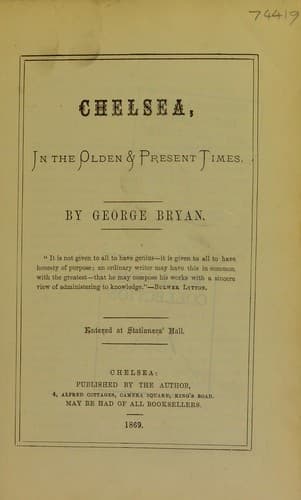
Chelsea, in the Olden & Present TimesBryan, George
History
Chelsea, in the Olden & Present Times
Bryan, George
Chelsea (London, England) -- History
SIR THOMAS MORE.—Against the south wall of the chancel is the monument of
Sir Thomas More, erected according to his own desire, in the year 1532.
The tablet on which the inscription is engraved is under a Tudor arch,
the cornice of which is ornamented with foliage, and in the centre of it
is his crest, viz., a Moor’s head. The spandrils of the arch are
ornamented with branches of the vine, and in the midst are his arms and
those of his first wife, and on each side are the arms of himself and his
two wives. The eventful history of More, and the termination of his
earthly career, must be familiar to the reader. After he was beheaded,
his body is said by some to have been interred in the church, but others
have contended that it was buried in St. Peter’s, in the Tower. There
are many legends respecting the head, but Mr. Brayley asserts positively
that it was finally deposited in St. Dunstan’s, near Canterbury, and that
he saw the head there many years ago. The inscription on the tablet is
of considerable length.
* * * * *
THE MARQUISE DE CUGNAC.—Near the Communion Table, against the south wall,
on a square ornamental slab, is an inscription to the memory of
Elizabeth, the wife of the Marquis de Cugnac. As a proof of his unshaken
love he erected this monument. She died in 1653, aged 20 years. The
marquis was of a Protestant family, famous in the reigns of Henry IV.,
Lewis XIII. and XIV.
* * * * *
THE SEDILE.—In the south wall of the chancel, near the altar, was usually
placed the “_Sedile_” a seat for the use of the priest at certain
intervals during the celebration of the Mass, but when the church was
almost rebuilt, in 1667, this ancient architectural ornament, and many
others were removed, and not a vestige of them now remains.
* * * * *
THOMAS HUNGERFORD, Esq.—In the upper chancel is the monument of the
above-named gentleman, having the effigies of himself and his two sons in
armour kneeling on one side of an altar, and his wife and daughter on the
other. The entablature is supported by three Corinthian pillars, resting
on pedestals.
* * * * *
REV. JOHN RUSH.—On the right of the one above are tablets to the memory
of the Rev. John Rush and family. He was Curate of the Parish for a
great many years, and when the new Parish Church was completed, Mr. Rush
became Minister of the Old Church, and resigned the curacy. He was one
of the Directors of the Waterloo Bridge Company, and took a great
interest in everything connected with the construction of that bridge.
He died in 1855, aged 85, and was buried in the Brompton Cemetery.
* * * * *
TWO DAUGHTERS OF WILTON, THE SCULPTOR.—Against the east wall is a
monument, composed of two urns of white marble, to the memory of Lucy
Smith and Anne Wilton, two sisters, 1781. Wilton, their father, was the
sculptor.
Public-domain text, read in full here on John Shaqi.
Reviews
Reviews
No reviews yet
Be the first to share your thoughts on this work.
Join the Discussion
Join the discussion
Sign in to leave a comment or review.
Sign InorCreate an account