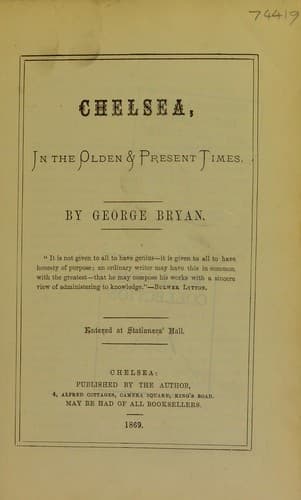
Chelsea, in the Olden & Present TimesBryan, George
History
Chelsea, in the Olden & Present Times
Bryan, George
Chelsea (London, England) -- History
Mr. Bowack says, “In the year 1667, the old Church, which was much
decayed, being too small to contain the congregation, grown large by the
vast increase of buildings about that time in the town,” (what would he
now think, in 1869, of the immense number of houses, and 70,000
inhabitants!) “it was agreed by the parishioners that part of it should
be demolished, and that such alterations and additions should be made as
were necessary for decent accommodation. Accordingly the shattered tower
and west end of the Church were pulled down, and the north and south
aisles carried several yards towards the west, by two brick walls, being
in all about 80 ft. from the ground. The walls of the Church were
raised, the windows enlarged, the old parts beautified, the inside new
paved, the churchyard considerably raised, and enclosed with a high wall
of brick; and most of this done at the voluntary charge of the
inhabitants, and the whole roof, lead, timber, &c., at the sole cost of
the Lady Jane Cheyne. The Church was furnished with all the necessary
ornaments, and the steeple with a good ring of six bells, by the bounty
of the inhabitants.”
From this statement it would appear that the Church was originally of
small dimensions.
MONUMENTS, &c.
It will not be asserting too much if we say that the Old Parish Church
contains more magnificent monuments, to the memories of distinguished
individuals, than are to be found in any other church in the metropolis.
LORD BRAY.—In the chancel, the most ancient monument is that of Lord
Bray, and of his son Lord John Bray. It is an altar-tomb, now much
defaced, but was originally ornamented with the effigies in brass of
these two noble lords, and with escutcheons of their arms. According to
Weever, there was the following inscription in his time:—“Of your
charitie pray for the soul of Edmund Bray, knight, Lord Bray, cosin and
heire to Sir Reginald Bray, Knight of the Garter.” There is a very long
and curious account of the funeral of Lord John Bray in the Herald’s
College, 1557.
* * * * *
Public-domain text, read in full here on John Shaqi.
Reviews
Reviews
No reviews yet
Be the first to share your thoughts on this work.
Join the Discussion
Join the discussion
Sign in to leave a comment or review.
Sign InorCreate an account