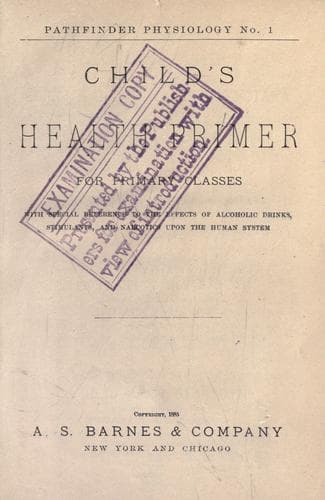
Child's Health Primer For Primary Classes: With Special Reference to the Effects of Alcoholic Drinks, Stimulants, and Narcotics upon The Human System — John Shaqi
Child's Health Primer For Primary Classes: With Special Reference to the Effects of Alcoholic Drinks, Stimulants, and Narcotics upon The Human SystemAndrews, Jane
General
Child's Health Primer For Primary Classes: With Special Reference to the Effects of Alcoholic Drinks, Stimulants, and Narcotics upon The Human System
Andrews, Jane
Hygiene -- Juvenile literature; Physiology -- Juvenile literature
He keeps it warm and moist in a place where he can watch it, and stop
the sprouting just in time to save the sugar, before it is used to feed
the root and stem. This sprouted grain is called malt.
The brewer soaks it in plenty of water, because the grain has not water
in itself, as the grape has.
He puts in some yeast to help start the work of changing the sugar into
gas[B] and alcohol.
Sometimes hops are also put in, to give it a bitter taste.
The brewer watches to see the bubbles of gas that tell, as plainly as
words could, that sugar is going and alcohol is coming.
When the work is finished, the barley has been made into beer.
It might have been ground and made into barley-cakes, or into pearl
barley to thicken our soups, and then it would have been good food. Now,
it is a drink containing alcohol, and alcohol is a poison.
You should not drink beer, because there is alcohol in it.
Two boys of the same age begin school together. One of them drinks
wine, cider, and beer. The other never allows these drinks to pass his
lips. These boys soon become very different from each other, because one
is poisoning his body and mind with alcohol, and the other is not.
A man wants a good, steady boy to work for him. Which of these two do
you think he will select? A few years later, a young man is wanted who
can be trusted with the care of an engine or a bank. It is a good
chance. Which of these young men will be more likely to get it?
REVIEW QUESTIONS.
1. Is there sugar in grain?
2. What is in the grain that can be turned into
sugar?
3. What can you do to a seed that will make its
starch turn into sugar?
4. What does the brewer do to the barley to make
its starch turn into sugar?
5. What is malt?
6. What does the brewer put into the malt to start
the working?
7. What gives the bitter taste to beer?
8. How does the brewer know when sugar begins to
go and alcohol to come?
9. Why does he want the starch turned to sugar?
10. Is barley good for food?
11. Why is beer not good for food?
12. Why should you not drink it?
13. Why did the two boys of the same age, at the
same school, become so unlike?
14. Which will have the best chance in life?
FOOTNOTE:
[Footnote B: Car bon´ic acid gas.]
CHAPTER VI.
DISTILLING.
[Illustration: D]ISTILLING (dĭs tĭlł´ing) may be a new word to you, but
you can easily learn its meaning.
You have all seen distilling going on in the kitchen at home, many a
time. When the water in the tea-kettle is boiling, what comes out at the
nose? Steam.
What is steam?
You can find out what it is by catching some of it on a cold plate, or
tin cover. As soon as it touches any thing cold, it turns into drops of
water.
Public-domain text, read in full here on John Shaqi.
Reviews
Reviews
No reviews yet
Be the first to share your thoughts on this work.
Join the Discussion
Join the discussion
Sign in to leave a comment or review.
Sign InorCreate an account