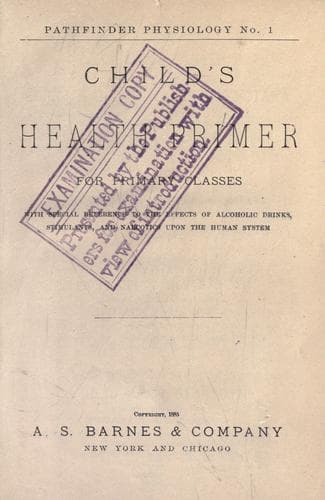
Child's Health Primer For Primary Classes: With Special Reference to the Effects of Alcoholic Drinks, Stimulants, and Narcotics upon The Human SystemAndrews, Jane
General
Child's Health Primer For Primary Classes: With Special Reference to the Effects of Alcoholic Drinks, Stimulants, and Narcotics upon The Human System
Andrews, Jane
Hygiene -- Juvenile literature; Physiology -- Juvenile literature
When we boil water and turn it into steam, and then turn the steam back
into water, we have distilled the water. We say vapor instead of steam,
when we talk about the boiling of alcohol.
It takes less heat to turn alcohol to vapor than to turn water to
steam; so, if we put over the fire some liquid that contains alcohol,
and begin to collect the vapor as it rises, we shall get alcohol first,
and then water.
But the alcohol will not be pure alcohol; it will be part water, because
it is so ready to mix with water that it has to be distilled many times
to be pure.
But each time it is distilled, it will become stronger, because there is
a little more alcohol and a little less water.
In this way, brandy, rum, whiskey, and gin are distilled, from wine,
cider, and the liquors which have been made from corn, rye, or barley.
The cider, wine, and beer had but little alcohol in them. The brandy,
rum, whiskey, and gin are nearly one-half alcohol.
A glass of strong liquor which has been made by distilling, will injure
any one more, and quicker, than a glass of cider, rum, or beer.
But a cider, wine, or beer-drinker often drinks so much more of the
weaker liquor, that he gets a great deal of alcohol. People are often
made drunkards by drinking cider or beer. The more poison, the more
danger.
REVIEW QUESTIONS.
1. Where have you ever seen distilling going on?
2. How can you distill water?
3. How can men separate alcohol from wine or from
any other liquor that contains it?
4. Why will not this be pure alcohol?
5. How is a liquor made stronger?
6. Name some of the distilled liquors.
7. How are they made?
8. How much of them is alcohol?
9. Which is the most harmful--the distilled
liquor, or beer, wine, or cider?
10. Why does the wine, cider, or beer-drinker
often get as much alcohol?
CHAPTER VII.
ALCOHOL.
[Illustration: A]LCOHOL looks like water, but it is not at all like
water.
Alcohol will take fire, and burn if a lighted match is held near it; but
you know that water will not burn.
When alcohol burns, the color of the flame is blue. It does not give
much light: it makes no smoke or soot; but it does give a great deal of
heat.
A little dead tree-toad was once put into a bottle of alcohol. It was
years ago, but the tree-toad is there still, looking just as it did the
first day it was put in. What has kept it so?
It is the alcohol. The tree-toad would have soon decayed if it had been
put into water. So you see that alcohol keeps dead bodies from
decaying.
Pure alcohol is not often used as a drink. People who take beer, wine,
and cider get a little alcohol with each drink. Those who drink brandy,
rum, whiskey, or gin, get more alcohol, because those liquors are nearly
one half alcohol.
Public-domain text, read in full here on John Shaqi.
Reviews
Reviews
No reviews yet
Be the first to share your thoughts on this work.
Join the Discussion
Join the discussion
Sign in to leave a comment or review.
Sign InorCreate an account