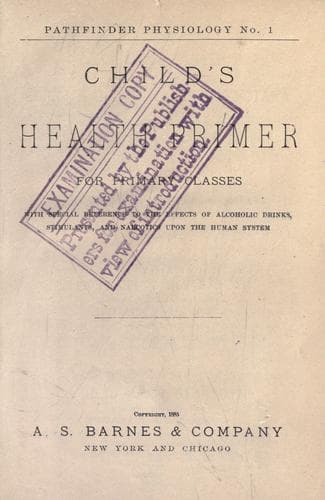
Child's Health Primer For Primary Classes: With Special Reference to the Effects of Alcoholic Drinks, Stimulants, and Narcotics upon The Human SystemAndrews, Jane
General
Child's Health Primer For Primary Classes: With Special Reference to the Effects of Alcoholic Drinks, Stimulants, and Narcotics upon The Human System
Andrews, Jane
Hygiene -- Juvenile literature; Physiology -- Juvenile literature
All this work goes on, day and night, without our needing to think about
it at all; for messages are sent to the muscles by the nerves which keep
them faithfully at work, whether we know it or not.
REVIEW QUESTIONS.
1. What covers the body?
2. What lines the body?
3. Where are the nerves of the skin?
4. What is perspiration? What is the common name
for it?
5. What are the pores of the skin?
6. How does the perspiration help to keep you
well?
7. Of what use are the nails?
8. How should they be kept?
9. What care should be taken of the skin?
10. Why should you not wear rubber boots or
overshoes in the house?
11. Why should you change under-clothing night and
morning?
12. Where should the night-dress be placed in the
morning?
13. What should be done with the bed-clothes? Why?
14. Name the four kinds of work about which you
have learned.
15. How are the organs of the body kept at work?
CHAPTER XVII.
THE SENSES.
[Illustration: W]E have five ways of learning about all things around
us. We can see them, touch them, taste them, smell them, or hear them.
Sight, touch, taste, smell, and hearing, are called the five senses.
You already know something about them, for you are using them all the
time.
In this lesson, you will learn a little more about seeing and hearing.
THE EYES.
In the middle of your eye is a round, black spot, called the pupil. This
pupil is only a hole with a muscle around it. When you are in the light,
the muscle draws up, and makes the pupil small, because you can get all
the light you need through a small opening. When you are in the dark,
the muscle stretches, and opens the pupil wide to let in more light.
The pupils of the cat's eyes are very large in the dark. They want all
the light they can get, to see if there are any mice about.
[Illustration: _The eyelashes and the tear-glands._]
The pupil of the eye opens into a little, round room where the nerve of
sight is. This is a safe place for this delicate nerve, which can not
bear too much light. It carries to the brain an account of every thing
we see.
We might say the eye is taking pictures for us all day long, and that
the nerve of sight is describing these pictures to the brain.
CARE OF THE EYES.
The nerves of sight need great care, for they are very delicate.
Do not face a bright light when you are reading or studying. While
writing, you should sit so that the light will come from the left side;
then the shadow of your hand will not fall upon your work.
One or two true stories may help you to remember that you must take good
care of your eyes.
Public-domain text, read in full here on John Shaqi.
Reviews
Reviews
No reviews yet
Be the first to share your thoughts on this work.
Join the Discussion
Join the discussion
Sign in to leave a comment or review.
Sign InorCreate an account