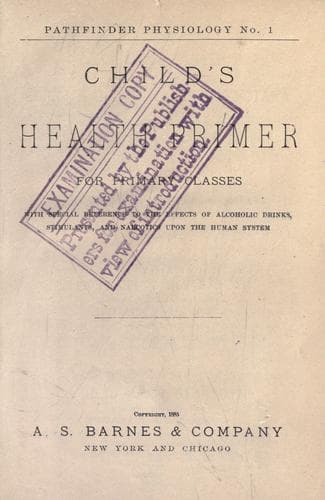
Child's Health Primer For Primary Classes: With Special Reference to the Effects of Alcoholic Drinks, Stimulants, and Narcotics upon The Human System — John Shaqi
Child's Health Primer For Primary Classes: With Special Reference to the Effects of Alcoholic Drinks, Stimulants, and Narcotics upon The Human SystemAndrews, Jane
General
Child's Health Primer For Primary Classes: With Special Reference to the Effects of Alcoholic Drinks, Stimulants, and Narcotics upon The Human System
Andrews, Jane
Hygiene -- Juvenile literature; Physiology -- Juvenile literature
The nerve of sight can not bear too bright a light. It asks to have the
pupil made small, and even the eyelid curtains put down, when the light
is too strong.
Once, there was a boy who said boastfully to his playmates: "Let us see
which of us can look straight at the sun for the longest time."
Then they foolishly began to look at the sun. The delicate nerves of
sight felt a sharp pain, and begged to have the pupils made as small as
possible and the eyelid curtains put down.
But the foolish boys said "No." They were trying to see which would bear
it the longest. Great harm was done to the brains as well as eyes of
both these boys. The one who looked longest at the sun died in
consequence of his foolish act.
The second story is about a little boy who tried to turn his eyes to
imitate a schoolmate who was cross-eyed. He turned them; but he could
not turn them back again. Although he is now a gentleman more than fifty
years old and has had much painful work done upon his eyes, the doctors
have never been able to set them quite right.
You see from the first story, that you must be careful not to give your
eyes too much light. But you must also be sure to give them light
enough.
When one tries to read in the twilight, the little nerve of sight says:
"Give me more light; I am hurt, by trying to see in the dark."
If you should kill these delicate nerves, no others would ever grow in
place of them, and you would never be able to see again.
THE EARS.
What you call your ears are only pieces of gristle, so curved as to
catch the sounds and pass them along to the true ears. These are deeper
in the head, where the nerve of hearing is waiting to send an account
of each sound to the brain.
CARE OF THE EARS.
The ear nerve is in less danger than that of the eye. Careless children
sometimes put pins into their ears and so break the "drum." That is a
very bad thing to do. Use only a soft towel in washing your ears. You
should never put any thing hard or sharp into them.
I must tell you a short ear story, about my father, when he was a small
boy.
One day, when playing on the floor, he laid his ear to the crack of the
door, to feel the wind blow into it. He was so young that he did not
know it was wrong; but the next day he had the earache severely.
Although he lived to be an old man, he often had the earache. He thought
it began from the time when the wind blew into his ear from under that
door.
ALCOHOL AND THE SENSES.
All this fine work of touching, tasting, seeing, smelling, and hearing,
is nerve work.
The man who is in the habit of using alcoholic drinks can not touch,
taste, see, smell, or hear so well as he ought. His hands tremble, his
speech is sometimes thick, and often he can not walk straight.
Sometimes, he thinks he sees things when he does not, because his poor
nerves are so confused by alcohol that they can not do their work.
Public-domain text, read in full here on John Shaqi.
Reviews
Reviews
No reviews yet
Be the first to share your thoughts on this work.
Join the Discussion
Join the discussion
Sign in to leave a comment or review.
Sign InorCreate an account