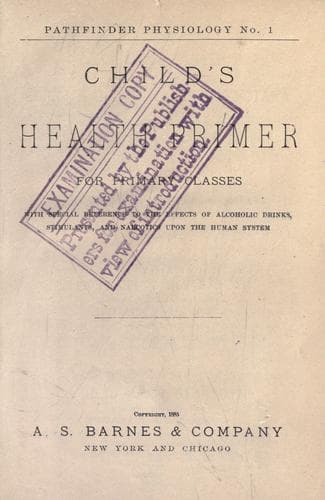
Child's Health Primer For Primary Classes: With Special Reference to the Effects of Alcoholic Drinks, Stimulants, and Narcotics upon The Human System — John Shaqi
Child's Health Primer For Primary Classes: With Special Reference to the Effects of Alcoholic Drinks, Stimulants, and Narcotics upon The Human SystemAndrews, Jane
General
Child's Health Primer For Primary Classes: With Special Reference to the Effects of Alcoholic Drinks, Stimulants, and Narcotics upon The Human System
Andrews, Jane
Hygiene -- Juvenile literature; Physiology -- Juvenile literature
Answer now for your taste, smell, and touch, and also for your sight and
hearing; should their beautiful work be spoiled by alcohol?
REVIEW QUESTIONS.
1. Name the five senses.
2. What is the pupil of the eye?
3. How is it made larger or smaller?
4. Why does it change in size?
5. What can a cat's eyes do?
6. Where is the nerve of the eye?
7. What work does it do?
8. Why must one be careful of his eyes?
9. Where should the light be for reading or
studying?
10. Tell the story of the boys who looked at the
sun.
11. Tell the story of the boy who made himself
cross-eyed.
12. Why should you not read in the twilight?
13. What would be the result, if you should kill
the nerves of sight?
14. Where are the true ears?
15. How may the nerves of hearing be injured?
16. Tell the story of the boy who injured his ear.
17. How is the work of the senses affected by
drinking liquor?
CHAPTER XVIII.
HEAT AND COLD.
WHAT MAKES US WARM?
"[Illustration: M]Y thick, warm clothes make me warm," says some child.
No! Your thick, warm clothes keep you warm. They do not make you warm.
Take a brisk run, and your blood will flow faster and you will be warm
very quickly.
On a cold day, the teamster claps his hands and swings his arms to make
his blood flow quickly and warm him.
Every child knows that he is warm inside; for if his fingers are cold,
he puts them into his mouth to warm them.
If you should put a little thermometer into your mouth, or under your
tongue, the mercury (mẽr´ku r[)y]) would rise as high as it does out of
doors on a hot, summer day.
This would be the same in summer or winter, in a warm country or a cold
one, if you were well and the work of your body was going on steadily.
WHERE DOES THIS HEAT COME FROM?
Some of the work which is all the time going on inside your body, makes
this heat.
The blood is thus warmed, and then it carries the heat to every part of
the body. The faster the blood flows, the more heat it brings, and the
warmer we feel.
In children, the heart pumps from eighty to ninety times a minute.
This is faster than it works in old people, and this is one reason why
children are generally much warmer than old people.
But we are losing heat all the time.
You may breathe in cold air; but that which you breathe out is warm. A
great deal of heat from your warm body is all the time passing off
through your skin, into the cooler air about you. For this reason, a
room full of people is much warmer than the same room when empty.
CLOTHING.
We put on clothes to keep in the heat which we already have, and to
prevent the cold air from reaching our skins and carrying off too much
heat in that way.
Public-domain text, read in full here on John Shaqi.
Reviews
Reviews
No reviews yet
Be the first to share your thoughts on this work.
Join the Discussion
Join the discussion
Sign in to leave a comment or review.
Sign InorCreate an account