Country life -- England -- Fiction; Dartmoor (England) -- Fiction
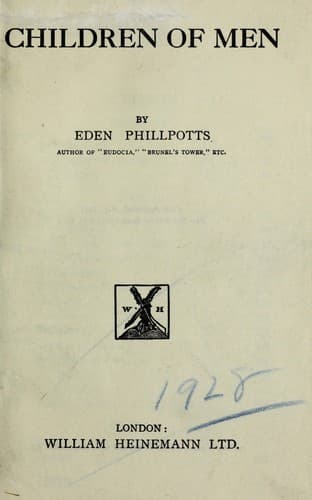
CHILDREN OF MEN
BY
EDEN PHILLPOTTS
AUTHOR OF "EUDOCIA," "BRUNEL'S TOWER," ETC.
LONDON
WILLIAM HEINEMANN LTD.
_First Published_, 1923
PRINTED IN GREAT BRITAIN BY WOODS & SONS, LTD., LONDON W.1.
FOREWORD
The egotism of a personal note may, for once, be permitted to me,
since an enterprise, launched some thirty years ago in 'Children of
the Mist,' now reaches its port of destination with the present
story. When 'Widecombe Fair' was written, that book appeared the end
of the matter; but fresh challenges from life on the Dartmoors, and
renewed strength to meet them, enabled me to add certain passages to
the total and render the design orbicular and complete. With
'Children of Men' it is accomplished and the purpose may be related
in brief words.
Without learning, or bias, or convictions to determine my trend, I
have said 'Yes' to life as it unfolded in this small theatre. Mine
was neither a great nor a subtle vision, but unvitiated within its
limitations.
Given faith that conscious Will is at the helm of human affairs, then
a definite attitude must result before the spectacle of humanity; but
if the mind be built to accept only unconscious Law as controller,
the outlook differs and a resolute trust may develop in man, as
ultimate arbiter of his own destiny. Neither assumption can be
proved, or disproved; but the relation of a controlling, guiding
Spirit to the Universe lies open to doubt; its subjection to Law does
not; and building upon this latter certainty, I discovered, in the
evolution of the moral principle, full cause for trust and for hope.
Observation has convinced me that moral evolution is upward, despite
massive, contemporary evidence to the contrary. For the War and the
peace alike I recognise as a transient paralysis of human reason, not
its negation. The War was an attack of familiar maladies for which
man's own errors of ignorance were to be condemned, not the laws of
his being; but it was an unutterable infamy and disgrace to him, for
this reason, that it proves him to be lagging behind the time-table
of moral evolution. Ere now he should have outgrown his present
stature, and the causes of his tardy progress, his centuries of
loitering in the desert, are as plain as pitiful. An impartial
ethics can point to where his faith took the wrong turn; but progress
in righteousness is only delayed; I have seen dawn upon the mountain
tops too often not to trust that it will presently descend into the
shadowed homes and sleeping hearts of men.
Public-domain text, read in full here on John Shaqi.
Reviews
Reviews
No reviews yet
Be the first to share your thoughts on this work.
Join the Discussion
Join the discussion
Sign in to leave a comment or review.
Sign InorCreate an account