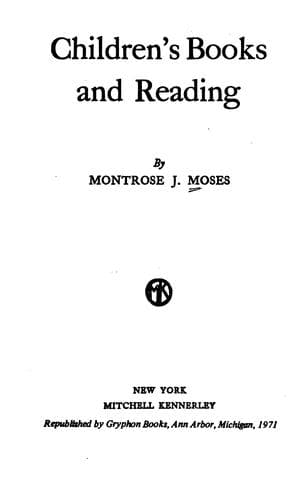
Children -- Books and reading; Children's literature -- Bibliography; Children's literature -- History and criticism
Can we recall any of our great men--literary, scientific, or
otherwise--who were brought up on distinctively juvenile literature.
A present-day boy who would read what Lamb or Wordsworth, Coleridge
or Tennyson, Gladstone or Huxley devoured with gusto in their youth,
would set the psychologists in a flutter, would become an object for
head-lines in our papers. There is a mistaken conception regarding
what are children’s books, in the best sense of the word. A standard
which might have excellent conservative results, although it would
be thoroughly one-sided and liable to false interpretation, could be
based on the assertion that those books only are children’s classics
which can be relished by a grown-up public. “Alice in Wonderland,” “The
Water Babies,” “Peter Pan”--such stories have a universal appeal. And
it is well to remember that at least five of the world’s classics, not
originally written for children, have been appropriated by them: “The
Arabian Nights”; “Pilgrim’s Progress”; “Robinson Crusoe”; “Gulliver’s
Travels”; “Baron Münchausen.”
With the reading democracy created by public libraries, there has
developed the need for this special kind of writing. Excesses have
unfortunately arisen such as made a critic once exclaim in disgust,
“Froissart is cut into spoon-meat, and Josephus put into swaddling
clothes.” While we shall, in the following pages, find many odd
theories and statements regarding simplification of style, it is as
well to be forearmed against this species of writing. Democracy in
literature is falsely associated with mediocrity. When one reads the
vitiating “series” class of story-book, the colourless college record,
the diluted historical narrative, there is cause for despair. But there
is no need for such cheapening. The wrong impression is being created
in the popular mind that literature is synonymous with dulness; that
only current fiction is worth while. And we find children confessing
that they rarely read non-fiction, a term they only dimly comprehend.
It is not right that a middle-class population should have relegated
to it a middle-class literature. Such, however, at the present moment,
seems to be the situation. And as a consequence all departments suffer.
Except for a very few volumes, there is no biography for children
that is worthy of endorsement, for the simple reason that the dignity
of a whole life, its meaning and growth, are subordinated to the
accentuation of a single incident. History becomes a handmaiden to the
slender story. Let those writers who are looking for an unworked vein
ponder this. The fictionising of all things is one of the causes for
this poverty; the text-book habit another.
The poet Blake sings:
“Thou hast a lap full of seed,
And this is a fine country.
Why dost thou not cast thy seed,
And live in it merrily?”
Public-domain text, read in full here on John Shaqi.
Reviews
Reviews
No reviews yet
Be the first to share your thoughts on this work.
Join the Discussion
Join the discussion
Sign in to leave a comment or review.
Sign InorCreate an account