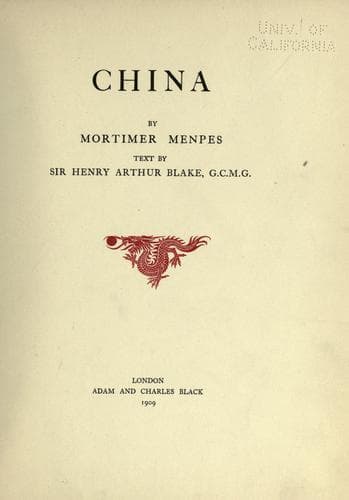
China -- Description and travel; China -- Social life and customs
The incident was the means of demonstrating the organizing capacity of
the Chinese. As soon as the sea had moderated sufficiently to allow a
launch to live, I sent for a Chinese gentleman and suggested that
something should be done to relieve the sufferers and rescue those who
still required assistance, and found that already the guild had sent
out two powerful launches, one with coffins for the drowned, the
other, with a doctor on board, equipped with the necessary means of
succour for the injured, and food for those who had lost their all.
Steaming along the Kowloon shore an hour afterwards, where the
wreckage of boats was heaving and falling in a mass of destruction
twenty to thirty feet wide along the sea wall, there was no sign, as
might have been expected, of stunned despair; but the crowd of
boat-people, men and women, who had escaped with their lives were
working with a will and as busy as bees, each endeavouring to save
something from the smashed wreckage of what had been their home, the
men jumping from one heaving mass to another, diving betimes and
struggling with the adverse buffets of fate with an energy none the
less for their stoical acceptance of the inevitable.
Although Hong Kong is a British possession it is essentially a Chinese
city. British supervision has seen to it that the streets are wide and
all the houses well and solidly built, save a few remaining houses of
the era preceding the creation of a sanitary board, and cleanliness of
house and surroundings is secured by careful and unremitting
inspection. The shops are a mixture of European architecture and
Chinese decoration, which runs into rich and elaborate carving and
gilding. Outside are hung the same pendant signs that give such colour
to the streets of Canton. Blue is the predominant colour worn by all
Chinese, save the sweating coolies who toil along the quays of the
great port, and the blue crowd that fills the busy streets harmonizes
with the surrounding colours. The splendid buildings in what are
called the principal streets, where banks, hotels, and counting-houses
of the important European firms are situated, with the shops that
cater more especially for the wants of foreign residents and tourists,
differ but little from the architecture of a European city, while the
shops contain all that purchasers can require of European wares, or
Chinese and Japanese products wherewith to tempt the inquiring
tourist. But the wealthiest part of the city is in the Chinese
quarter, and here property has changed hands at startling figures,
sometimes at a rate equal to one hundred and sixty thousand pounds an
acre. Here the shops are purely Chinese, and every trade may be seen
in operation, while the doctor puts up a sign that he cures broken
legs, or the dentist displays a small board, from which hang five or
six long strings of molars of portentous size showing every phase of
dental decay. Everywhere is seen a teeming population instinct with
ceaseless activity.
Public-domain text, read in full here on John Shaqi.
Reviews
Reviews
No reviews yet
Be the first to share your thoughts on this work.
Join the Discussion
Join the discussion
Sign in to leave a comment or review.
Sign InorCreate an account