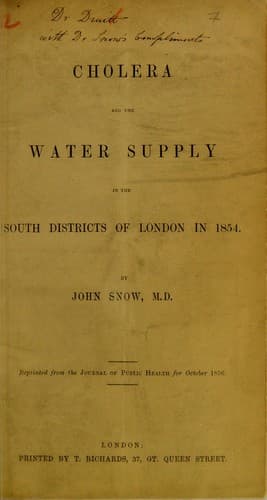
Cholera and the Water Supply in the South Districts of London in 1854Snow, John
History
Cholera and the Water Supply in the South Districts of London in 1854
Snow, John
Cholera -- England -- London -- Epidemiology; Water-supply -- England -- London
case, the whole of the phenomena of cholera, as an epidemic, could not
be explained. I, therefore, sought anxiously, and waited patiently, for
some confirmation of this part of the subject before I should make my
views known. Two outbreaks of cholera occurred, however, about the end
of July 1849, one in Horsleydown, and the other in the Wandsworth Road,
which I investigated, and which afforded what I considered conclusive
evidence on the subject. The water drank by the persons attacked in each
of these outbreaks had received, amongst other impurities, what must
have come from a patient previously ill of the disease. I was able also
to point out that the cholera was prevailing most in those districts of
the metropolis which received their supply of water from certain parts
of the Thames which contained the sewage of the town, and, consequently,
whatever proceeded from the cholera patients. Before the end of 1849 I
was able to show that a very close connexion existed between the
mortality from cholera and the nature of the water supply, not only in
London, but throughout the country. This connexion was very evident in
certain towns, as Exeter and Hull, where the supply of water had been
changed between the epidemic of 1832 and that of 1849. Where a polluted
supply was changed for an unpolluted one, the cholera was almost
prevented; and where a scanty but unpolluted supply had been changed for
one contaminated with the sewage of the town, the epidemic prevailed to
a fearful extent. The attention of Dr. Wm. Budd and Dr. Farr was
directed to this subject, with the result of confirming what I had
stated.
Between the epidemics of 1849 and that of 1853, one of the water
companies supplying the south districts of London changed its source of
supply from the middle of the town, near the foot of the Hungerford
Suspension Bridge, to Thames Ditton, at a part of the river which is
beyond the influence of the tide, and, therefore, out of reach of the
sewage of the metropolis. In the autumn of 1853 it was shown by Dr.
Farr[1] that the districts partly supplied by this, the Lambeth Water
Company, with improved water, suffered less than the districts supplied
entirely by the Southwark and Vauxhall Company with the water from the
river at Battersea Fields, although in 1849 they had suffered rather
more than the latter districts. By showing the water supply in
subdistricts, and thus getting a more correct line of demarcation, I was
able to point out[2] that the advantage in favour of the population
partly supplied with the purer water was even greater than Dr. Farr had
indicated.
Public-domain text, read in full here on John Shaqi.
Reviews
Reviews
No reviews yet
Be the first to share your thoughts on this work.
Join the Discussion
Join the discussion
Sign in to leave a comment or review.
Sign InorCreate an account