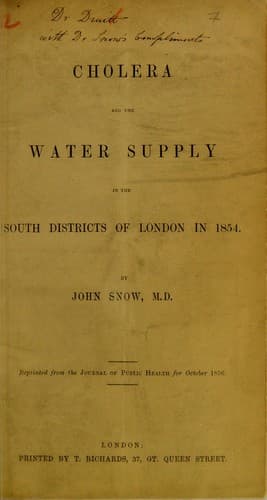
Cholera and the Water Supply in the South Districts of London in 1854Snow, John
History
Cholera and the Water Supply in the South Districts of London in 1854
Snow, John
Cholera -- England -- London -- Epidemiology; Water-supply -- England -- London
I had learnt from the evidence of Mr. Quick in the _Health of Towns
Reports_, that the division of the houses, between the Lambeth Company
on the one hand, and the Southwark and Vauxhall Company on the other,
was not such as obtains in the north districts of London, where a parish
is often divided between two water companies, but where one company
always leaves off at the point at which the other begins. Throughout the
greater part of Lambeth and Southwark, the whole of Newington, and a
part of Camberwell, however, the supply of the two companies above
mentioned is actually intermixed, the pipes of both companies going down
the same streets, in consequence of the active competition which once
existed between three water companies, two of which have since
amalgamated and come to an agreement with the other—the Lambeth company.
Observing, therefore, when the cholera returned in 1854, that there was
the same advantage in favour of the districts partly supplied with water
from Thames Ditton, I determined to make an inquiry, the idea of which I
had previously entertained. It was obvious that, if the diminished
mortality depended on the improved supply of water, the benefit of the
whole diminution would be enjoyed by the inhabitants of houses having
this supply, whilst the population receiving impure water would suffer
as much as that of the districts which received the same water, and no
other. This point could be determined by ascertaining the water supply
of every house in which a fatal attack of cholera might occur. After
commencing the inquiry I found that the circumstances were calculated
for affording even more conclusive evidence than I had anticipated. The
pipes of the two water companies not only passed down all the streets,
but into nearly all the courts and alleys. A single house often had a
different supply from that on either side. Each water company supplied
alike both rich and poor, and thus there was a population of 300,000
persons, of various conditions and occupations, intimately mixed
together, and divided into two groups by no other circumstance than the
difference of water supply. One group supplied with water contaminated,
to a large extent, with the sewage of London, and the other receiving a
supply altogether free from such impurity.
Public-domain text, read in full here on John Shaqi.
Reviews
Reviews
No reviews yet
Be the first to share your thoughts on this work.
Join the Discussion
Join the discussion
Sign in to leave a comment or review.
Sign InorCreate an account