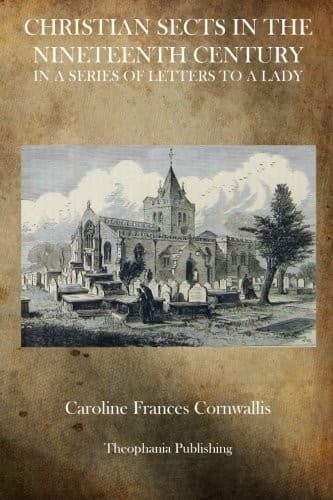
Christian Sects in the Nineteenth CenturyCornwallis, Caroline Frances
Religion
Christian Sects in the Nineteenth Century
Cornwallis, Caroline Frances
Christian sects -- History -- 19th century
When the preaching of Luther and his coadjutors had effectually called
men’s attention to the affairs of the church, it was natural that
questions with regard to its government no less than its doctrine, should
be freely mooted. The usurpations of Rome had a tendency to disgust the
Reformers with episcopal government, and accordingly we find both Calvin
and Luther establishing a more republican form; and instead of giving the
ecclesiastical power into the hands of one man, they judged it proper to
delegate it to the elders (presbyters) of each church respectively;
subject only to the control of the majority of a general synod. Such was
the origin of what we now term Presbyterians as a sect: for in _England_
more moderate councils, and the circumstance that the reformed tenets
were embraced by many of the bishops, led to retaining the Episcopal form
of church government. In _Scotland_, after a struggle, the Presbyterian
form was finally established, and the church or kirk of that part of
Great Britain is regulated upon that system. A secession has lately
taken place on the question of the right of presentation to livings, but
the _doctrine_ taught in both is nearly similar, i.e. that of the
Calvinistic churches.
The General Synod of Ulster (originally a branch of the established kirk
of Scotland), is the principal body of Presbyterians considered as
dissenters from the establishment: and there also, there is a
Presbyterian Synod, or Church of “the Apostolic Seceders,” formed by
seceders from the General Synod, which is thoroughly Calvinistic, and
which maintains the same discipline that is usually observed among the
seceding “Scottish Presbyterians.” In the reign of Geo. I. Arianism
{102} was openly embraced by some of the more speculative of the
Presbyterian ministers in Ireland, and in consequence, a theological
controversy was carried on for twenty years (from 1705 to 1725), which
ended in the secession of eight Arian ministers, and the formation of the
Presbytery of Antrim. Some who were secretly inclined to Arianism had
not the courage to follow the example of the eight seceders, and the
leaven continued to spread among the general body during the latter part
of the eighteenth century, till at length inquiries were instituted in
the Synod, which led to a fresh separation. Seventeen at length seceded
out of thirty-seven ministers, holding Arian or Socinian tenets in the
year 1830, and they subsequently formed themselves into a distinct Synod,
under the name of “the Remonstrant Synod of Ulster,” and the Presbytery
of Antrim has now become incorporated with this Synod. These Arian
congregations are chiefly situated in the counties of Antrim and Down, in
the north and eastern part of the province. There are ten or twelve
congregations in the south of Ireland forming the Synod of Munster, which
were also, till within a few years, Arian or Socinian. The total number
Public-domain text, read in full here on John Shaqi.
Reviews
Reviews
No reviews yet
Be the first to share your thoughts on this work.
Join the Discussion
Join the discussion
Sign in to leave a comment or review.
Sign InorCreate an account