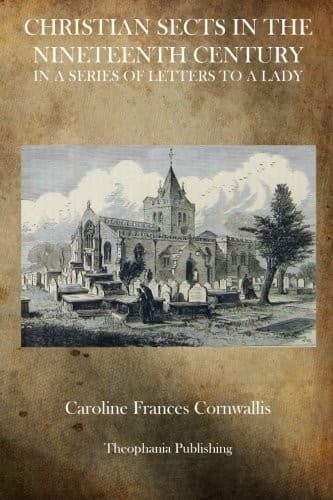
Christian Sects in the Nineteenth Century — John Shaqi
Christian Sects in the Nineteenth CenturyCornwallis, Caroline Frances
Religion
Christian Sects in the Nineteenth Century
Cornwallis, Caroline Frances
Christian sects -- History -- 19th century
of Remonstrant and Socinian congregations is between thirty and forty.
_All_ the Presbyterian bodies,—Orthodox and Arian, share in the
Government grants known under the name of “Regium Donum.” This royal
bounty was originally dispensed among the Presbyterian clergy of Ulster
in lieu of the tithes which were taken from them at the Restoration, and
bestowed upon the Episcopal conformists. It was withdrawn towards the
close of the reign of Charles II.; but at the Revolution, letters patent
passed the great seal of Ireland, granting £1200 per annum to seven
Presbyterian ministers, during pleasure, for the use of the ministers of
the north of Ireland, to be paid quarterly out of any of the revenues of
the kingdom. This grant was renewed, under certain limitations, in the
reign of Queen Anne: and in the reign of Geo. I. £800 per annum was
divided in equal shares between the ministers of the Ulster Synod and
those of the Southern Association. In 1784 an additional grant was made
to the Ulster Synod of £1000 per annum. In 1792 the grant was augmented
to £5000 to be divided among the ministers of the Synod,—the Presbytery
of Antrim,—the Seceders,—the Southern Association,—and the ministers of
the French church, Dublin. In 1803 some fresh regulations were made, by
which the distribution of the bounty was taken immediately into the hands
of Government, and the Presbyterian clergy were thus rendered more
ostensibly what they had previously been only in effect, i.e.,
stipendiaries of the state. The congregations under the care of the
several Synods and Presbyteries are now arranged in three classes
according to the number of families and the stipend of each minister; and
the allowance to the ministers of the three classes was fixed at £50,
£75, and £100 per annum. The members of the congregation feel under no
obligation to contribute much, if anything, to their pastor’s support,
who is therefore often compelled to have recourse to farming, grazing, or
some other secular employment, for the support of his family.
“In 1834 the ascendant party in the Synod succeeded in carrying a
resolution enforcing unqualified subscription to the “Confession of
Faith,” which had not previously been enforced. The ostensible motive
for this is a desire to bring about a closer union with the Established
Church of Scotland. The Irish Synod being now so far connected with the
state as to form a species of ecclesiastical establishment, a feeling has
been generated in favour of the established church of both countries: a
strong protest, however has been made against the decision, but without
avail.” {106}
The increase of the Presbyterians in Ireland from whatever cause has
borne no due proportion to that of the general population.
Public-domain text, read in full here on John Shaqi.
Reviews
Reviews
No reviews yet
Be the first to share your thoughts on this work.
Join the Discussion
Join the discussion
Sign in to leave a comment or review.
Sign InorCreate an account