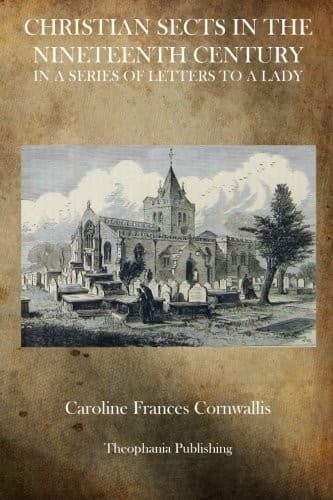
Christian Sects in the Nineteenth CenturyCornwallis, Caroline Frances
Religion
Christian Sects in the Nineteenth Century
Cornwallis, Caroline Frances
Christian sects -- History -- 19th century
“Ordination alone,” say the Independents, “without the precedent consent
of the Church by those who formerly have been advanced by virtue of that
power they have received by their ordination, doth not constitute any
person a church officer, or communicate office power unto him.” The
Presbyterians on the other hand deny that the mere invitation and choice
of the people could confer the pastoral office, or that it was even a
pre-requisite. The Independents seem to have identified the ministerial
function with the pastoral office; and argued that it was absurd to
ordain an officer without a province to exercise the office in. Their
opponents viewed the Christian ministry more as an order invested with
certain inherent powers; a faculty or profession endowed with peculiar
privileges, the admission into which required to be jealously guarded;
and this power and authority they conceive could be transmitted by those
of the order. All approved candidates for the ministerial office among
the Presbyterians, are ordained without reference to any local change;
among the Independents no probationer is ordained till he has been
appointed to the pastoral office. The first Independent or
Congregational Church in England was established by a Mr. Jacob, A.D.
1616, though it is asserted that a Mr. Robinson was the founder of this
sect, of which Dr. John Owen, Dr. Isaac Watts, Dr. Doddridge, and Job
Orton were members.
The following extracts are from the discourses of Robert Hall, who,
though a Baptist, dissented from most of his brethren on the subject of
strict communion. He was a preacher both of Baptist and Independent
congregations, but he did not hesitate to avow that “he had more
fellowship of feeling for an Independent or a Presbyterian than for a
close communion Baptist.” His system of theological tenets was on the
model of what has come to be denominated “Moderate Calvinism.” With
regard to the distinctive Calvinistic doctrine of Predestination, “I
cannot,” says his biographer, “answer for the precise terms in which he
would have stated it, but I presume he would have accepted those employed
by the Church of England. In preaching he very rarely made any express
reference to that doctrine.”
Public-domain text, read in full here on John Shaqi.
Reviews
Reviews
No reviews yet
Be the first to share your thoughts on this work.
Join the Discussion
Join the discussion
Sign in to leave a comment or review.
Sign InorCreate an account