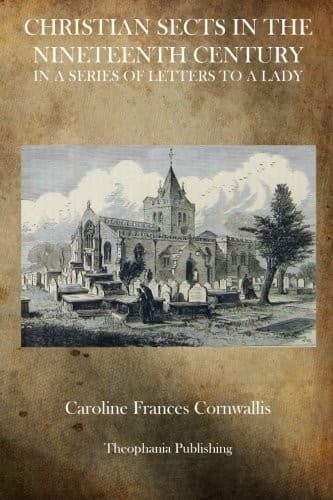
Christian Sects in the Nineteenth CenturyCornwallis, Caroline Frances
Religion
Christian Sects in the Nineteenth Century
Cornwallis, Caroline Frances
Christian sects -- History -- 19th century
“Presbyterianism received as a scheme of policy, though admirably adapted
to the exigencies of the times in which it originated, partakes of the
essential defectiveness of the incipient reformation of the sixteenth
century, embodying these erroneous principles which were adopted by the
founders of most of the Protestant churches, and which soon proved not
less fatal to the cause of scriptural truth than to the internal peace of
the Christian communities.”
The first Presbyterian church was founded in Geneva by John Calvin, about
A.D. 1541, and the system afterwards introduced into Scotland, with
modifications by John Knox, about the year 1560, but not _legally_
established there till 1592. It has never flourished greatly in England,
and the Unitarian doctrine has now been almost universally received among
the quondam Presbyterian congregations.
The _theory_ of discipline in the SCOTTISH CHURCH does not differ very
widely from that of the English episcopacy, but the _practice_ of the two
churches, as modified by the habits of the two nations, is totally
different. In order to reconcile the Anglican and Scottish confessions
of faith, it would be requisite that the Church of England should consent
to suppress Articles III. VII. XXXV. and XXXVI. also that part of Art.
VI. which sanctions the public reading of the Apocrypha, and the first
clause of Art. XX, attributing to the church a power to decree rites and
ceremonies, as well as authority in controversies of faith. Agreeing, as
the English and Scottish Churches do _substantially_ in the doctrines of
the Protestant faith, they nevertheless differ widely,
1. As to the nature of holy orders and the power of ordination.
2. As to the hierarchical constitution of the Anglican Church.
3. As to matters of ritual, especially the use of liturgies which the
Church of Scotland rejects.
4. As to the doctrines of sacramental grace and sacerdotal absolution,
implied in the offices of the Anglican Church.
5. As to the whole system of discipline, Ecclesiastical Courts, &c.
6. As to certain points of Calvinistic theology.
* * * * *
The INDEPENDENTS differ from the Presbyterians chiefly in three points,
namely:
1. As to ordination, and the liberty of preaching.
2. As to the political form and constitution of church government, and
the conditions of church communion.
3. As to the grounds and limits of religious liberty.
Public-domain text, read in full here on John Shaqi.
Reviews
Reviews
No reviews yet
Be the first to share your thoughts on this work.
Join the Discussion
Join the discussion
Sign in to leave a comment or review.
Sign InorCreate an account