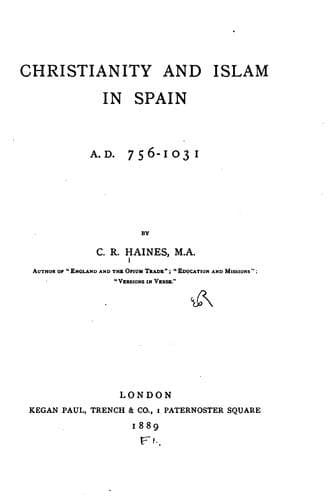
Christianity and Islam in Spain, A.D. 756-1031Haines, Charles Reginald
Islamic
Christianity and Islam in Spain, A.D. 756-1031
Haines, Charles Reginald
Christian martyrs -- Spain; Christianity -- Spain; Islam -- Spain
[2] Neander (l.l.) Blunt, Art. on Adopt., puts this
differently: "There were (according to Felix) two births in our
Lord's life--(a) the assumption of man at the conception; (_b_)
the adoption of that man at baptism. Cp. Contra Felic., iii.
16: "Qui est Secundus Adam, accepit has geminas generationes;
primam quae secundum carnem est, secundum vero spiritatem, quae
per adoptionem fit, idem redemptor noster secundum hominem
complexus, in semet ipso continet, primam videlicet, quam
suscepit ex virgine nascendo, secundam vero quam initiavit in
lavacro [ ] a mortuis resurgendo."
[3] Blunt, article on Adopt.
[4] Cp. Paschasius: "In Christo gemina substantia, non gemina
persona est, quia persona personam consumere potest, substantia
vero substantiam non potest, siquidem persona res iuris est,
substantia res naturae."
[5] Blunt, _ibid._ Cp. also Alcuin contra Felic., iv. 5, where
he says that Felix, although he shrank from asserting the dual
personality of Christ, yet insisted on points which involved
it.
[6] So Walchius.
The first mention of the new theory appears in a letter of Elipandus to
the Abbot Fidelis, written in 783,[1] but it did not attract notice
till a little later. The pope Adrian, in his letter to the orthodox
bishops of Spain (785), speaks of the melancholy news of the heresy
having reached him--a heresy, he remarks, never before propounded,
unless by Nestorius. Together with Elipandus, he mentions Ascarius,[2]
Bishop of Braga, whom Elipandus had won over to his views. The new
doctrine seems to have made its way quickly over a great part of
Spain,[3] while Felix propagated it with considerable success in
Septimania. The champions of the orthodox party in Spain were Beatus and
Etherius, whom we have mentioned above, and Theudula, Bishop of Seville;
while beyond its borders Alcuin, Paulinus of Aquileia, and Agobard of
Lyons, under the direction of Charles the Great and the Pope, defended
the orthodox position.
[1] See Migne, 96 p. 848.
[2] Fleury, v. 236, mentions a letter of his to Elipandus,
asking the latter's opinion on some doubtful points in the new
doctrine.
[3] Jonas of Orleans, in his work against Claudius, says: "Hac
virulenta doctrina uterque Hispaniam magna ex parte infecit."
Public-domain text, read in full here on John Shaqi.
Reviews
Reviews
No reviews yet
Be the first to share your thoughts on this work.
Elsewhere in the archive
Join the Discussion
Join the discussion
Sign in to leave a comment or review.
Sign InorCreate an account