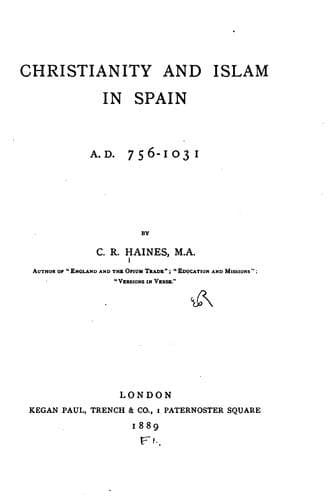
Christianity and Islam in Spain, A.D. 756-1031Haines, Charles Reginald
Islamic
Christianity and Islam in Spain, A.D. 756-1031
Haines, Charles Reginald
Christian martyrs -- Spain; Christianity -- Spain; Islam -- Spain
Felix, being bishop in a province of which Charles claimed the
overlordship, was amenable to his ecclesiastical superiors, and suffered
for his opinions at their hands; but Elipandus, living under a
Mohammedan government, could only be reached by letters or messages. He
seems even to have received something more than a mere negative support
from the Arabs, if we are right in so interpreting a passage in the
letter of Beatus and Etherius.[1] But it is hard to believe that
Elipandus was on such friendly terms with the Arab authorities; indeed,
from passages in his writings, we should infer that the opposite was
rather the case.[2] Neander suggests that it may have been a Gothic
king in Galicia who supported Elipandus, but this seems even more
unlikely than the other supposition.
The first council called to consider this question was held by the
suggestion of the Emperor and the Pope at Narbonne in 788, when the
heresy was condemned by twenty-five bishops of Gaul.[3]
A similar provincial council was held by Paulinus at Friuli in 791, with
the same results.[4] But in the following year the heresy was formally
condemned at a full council held at Ratisbon, under the presidency of
the Emperor. Here Felix abjured his error, and was sent to Rome to be
further condemned by the Pope, that the whole Western Church might take
action in the matter. Felix was there induced to write a book condemning
his own errors, but in spite of this he was not restored to his see.[5]
On his return, however, to Spain, Felix relapsed into his old heresy,
which he had never really abjured.[6]
[1] I. sec. 13. "Et episcopus metropolitanus et princeps terrae
pari certamine schismata haereticorum, unus verbi gladio, alter
virga regiminis ulciscens, de terra vestra funditus
auferantur." See on this passage Neander, v. 227, and cp. sec.
65, "haereticus tamen scripturarum non facit rationem, sed cum
potentibus saeculi ecclesiam vincere quaerit."
[2] Elip. ad. Albinum, sec. 7--"Oppressione gentis afflicti non
possumus tibi rescribere cuncta;" also, Ad Felic. "quotidiana
dispendia quibus duramus potius quam vivimus."
[3] There are some doubts about this council.
[4] Fleury, v. 236. Hefele dates it 796.
[5] See letter of Spanish bishops to Charles, asking for
Felix's restoration (794).
[6] Leo III. said of him, at a council held in Rome (799):
"_Fugiens ad paganos consentaneos_ perjuratus effectus est."
See Froben, "Dissert," sec. 24; apud Migne, ci, pp. 305-336.
Public-domain text, read in full here on John Shaqi.
Reviews
Reviews
No reviews yet
Be the first to share your thoughts on this work.
Elsewhere in the archive
Join the Discussion
Join the discussion
Sign in to leave a comment or review.
Sign InorCreate an account