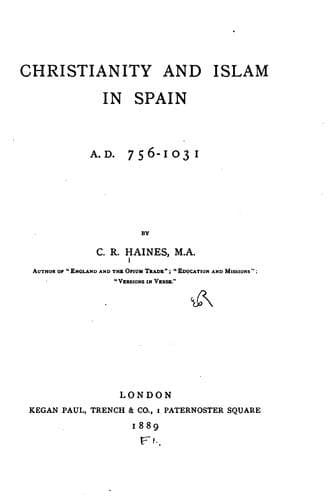
Christianity and Islam in Spain, A.D. 756-1031Haines, Charles Reginald
Islamic
Christianity and Islam in Spain, A.D. 756-1031
Haines, Charles Reginald
Christian martyrs -- Spain; Christianity -- Spain; Islam -- Spain
In 792 Alcuin was summoned from England to come and defend the orthodox
position. He wrote at once to Felix a kindly letter, admonishing him of
his errors, and acknowledging that all his previous utterances on
theology had been sound and true. Felix answered this letter, but his
reply is not preserved. To the same, or following, year belongs the
letter of Elipandus and the bishops of Spain to Charles and the bishops
of Gaul, defending their doctrine, and asking for the restoration of
Felix.
In 794 was held another council at Frankfurt, at which Alcuin and other
English clergy were present. Felix was summoned to attend, and heard his
heresy again condemned and anathematised, the decree to this effect
being sent to Elipandus.[1] Alcuin's book was read by Charles, and sent
into Septimania by the hands of the abbot Benedict.
The next council was held at Rome in 798 to confirm the one at
Frankfurt.[2] In 799 came out Felix's answer to Alcuin, sent by him
first to Elipandus, and, after being shewn to the Cordovan clergy, sent
on to Charles. Alcuin is charged to answer it, with Paulinus and the
Pope as his coadjutors.
In the same year another council was held at Aix, where Alcuin argued
for a week with Felix, and apparently convinced him, for Felix again
recanted, and even wrote a confession of faith discarding the word
adoption, but still preserving the distinction of predicates belonging
to the two natures.[3] Alcuin's book, after being revised by Charles,
was published 800 A.D. Previously to this he had written to Elipandus,
who answered in no measured terms, accusing Alcuin, among other things,
of enormous wealth. This letter was sent through Felix, and, in answer,
Alcuin wrote the book against Elipandus, which we now have, and which
was the means of converting twenty thousand heretics in Gothic Gaul.[4]
But in spite of Emperor or Pope, of the books of Alcuin, or the
anathemas of the councils, neither Felix nor Elipandus really gave up
his new doctrines, and even the former continued to make converts.
Elipandus, though very old[5] at this time (800 A.D.), lived ten years
longer, and Felix survived him eight years;[6] and they both died
persisting in their error.[7]
[1] Fleury, v. 243, says there was no anathema; but Migne,
xcvi. 858, gives us the canon: "Anathematizata esto impia ac
nefanda haeresis Elipandi Toletanae sedis Episcopi, et Felix
(_sic_) Orgellitani, eorumque sequacium."
[2] Neander, v. 228.
[3] _Ibid._, p. 232.
[4] Froben, sec, 82. Neander says 10,000.
[5] Alcuin adv. Elip. Preface to Leidrad: "Non pro eius
tantummodo laboravi salute, quem timeo forsan citius vel morte
praereptum esse propter decrepitam in eo senectutem."
[6] Or perhaps six.
Public-domain text, read in full here on John Shaqi.
Reviews
Reviews
No reviews yet
Be the first to share your thoughts on this work.
Elsewhere in the archive
Join the Discussion
Join the discussion
Sign in to leave a comment or review.
Sign InorCreate an account