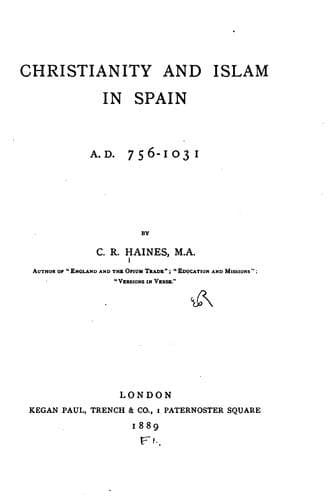
Christianity and Islam in Spain, A.D. 756-1031Haines, Charles Reginald
Islamic
Christianity and Islam in Spain, A.D. 756-1031
Haines, Charles Reginald
Christian martyrs -- Spain; Christianity -- Spain; Islam -- Spain
[1] _E.g._, Alhorr ibn Abdurrahman (717-719); see Isidore, sec.
44, and Conde, i. 94: "He oppressed all alike, the Christians,
those who had newly embraced Islam, and the oldest of the
Moslemah families."
[2] Merely a small poll-tax (jizyah) at first.
[3] Conde, i. 105.
[4] Conde, i. p. 99. Isidore, however, sec. 52, says:
"Vectigalia Christianis duplicata exagitat."
[5] Conde, i. 102.
[6] Isidore, sec. 54. Terribilis potestator fere triennio
crudelis exaestuat, atque aeri ingenio Hispaniae Sarracenos et
Mauros pro pacificis rebus olim ablatis exagitat, atque
Christianis plura restaurat.
[7] Conde, i. 114, 115.
Most of the first conquerors of the country were Berbers, while such
Arabs as came in with them belonged mostly to the Maadite or Beladi
faction.[1] The Berbers, besides being looked down upon as new converts,
were also regarded as Nonconformists[2] by the pure Arabs, and
consequently a quarrel was not long in breaking out between the two
parties.
As early as 718 the Berbers in Aragon and Catalonia rose against the
Arabs under a Jew named Khaulan, who was put to death the following
year. In 726 they revolted again, crying that they who had conquered the
country alone had claims to the spoil.[3] This formidable rising was
only put down by the Arabs making common cause against it. But the
continual disturbances in Africa kept alive the flame of discontent in
Spain, and the great Berber rebellion against the Arab yoke in Africa
was a signal for a similar determined attempt in Spain.[4] The
reinforcements which the Khalif, Yezid ibn Abdulmalik, sent to Africa
under Kolthum ibn Iyadh were defeated by the Berbers under a chief named
Meysarah, and shut up in Ceuta.
[1] The two chief branches of Arabs were (1) Descendants of
Modhar, son of Negus, son of Maad, son of Adnan. To this clan
belonged the Mecca and Medina Arabs, and the Umeyyade family.
They were also called Kaysites, Febrites, and Beladi Arabs. (2)
Descendants of Kahtan (Joktan), among whom were reckoned the
Kelbites and the Yemenites. These were most numerous in
Andalus; see Al Makkari, ii. 24.
[2] Dozy, iii. 124. See Al Makk., ii. 409, De Gayangos' note.
Though nominally Moslem, they still kept their Jewish or Pagan
rites.
[3] See De Gayangos, Al Makk. ii. 410, note. He quotes Borbon's
"Karta," xiv. _sq._ Stanley Lane-Poole, "Moors in Spain," p.
55, says, Monousa, who married the daughter of Eudes, was a
leader of the Berbers. Conde, i. 106, says, Othman abi Neza was
the leader, but Othman an ibn abi Nesah was Ameer of Spain in
728.
[4] Al Makkari, ii. 40.
Public-domain text, read in full here on John Shaqi.
Reviews
Reviews
No reviews yet
Be the first to share your thoughts on this work.
Join the Discussion
Join the discussion
Sign in to leave a comment or review.
Sign InorCreate an account