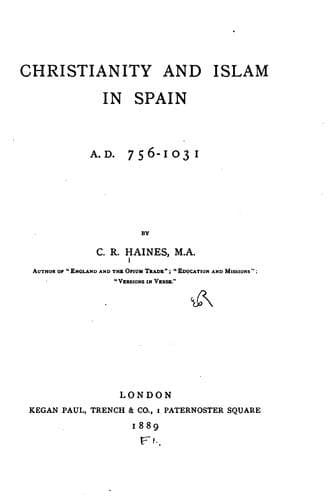
Christianity and Islam in Spain, A.D. 756-1031Haines, Charles Reginald
Islamic
Christianity and Islam in Spain, A.D. 756-1031
Haines, Charles Reginald
Christian martyrs -- Spain; Christianity -- Spain; Islam -- Spain
Meanwhile in Spain, Abdalmalik ibn Kattan[1] Alfehri taking up the cause
of the Berbers, procured the deposition of Okbah ibn ulhejaj in his own
favour, but, this done, broke with his new allies. He was then compelled
to ask the help of the Syrian Arabs, who were cooped up in Ceuta, though
previously he had turned a deaf ear to their entreaties that they might
cross over into Spain.
The Syrians gladly accepted this invitation, and under Balj ibn Besher,
nephew of Kolthum, crossed the Straits, readily promising at the same
time to return to Africa when the Spanish Berbers were overcome. This
desirable end accomplished, however, they refused to keep to their
agreement, and Abdalmalik soon found himself driven to seek anew the
alliance of the Berbers and also of the Andalusian Arabs against his
late allies.[2] But the latter proved too strong for the Ameer, who was
defeated and killed by the Yemenite followers of Balj.
[1] Cardonne, i. p. 135.
[2] The Syrian Arabs seem to have borne a bad character away
from home. The Sultan Muawiyah warned his son that they altered
for the worse when abroad. See Ockley's "Saracens."
These feuds of Yemenites against Modharites, complicated by the
accession of Berbers now to one side, now to the other, continued
without intermission till the first Khalif of Cordova, Abdurrahman ibn
Muawiyah, established his power all over Spain.
The successor of Balj and Thaleba ibn Salamah did indeed try to break up
the Syrian faction by separating them. He placed those of Damascus in
Elvira; of Emesa in Seville; of Kenesrin in Jaen; of Alurdan[1] in
Malaga and Regio; of Palestine in Sidonia or Xeres; of Egypt in Murcia;
of Wasit in Cabra; and they thus became merged into the body of
Andalusian Arabs.
These Berber wars had an important influence on the future of Spain;
for, since the Berbers had settled on all the Northern and Western
marches, when they were decimated by civil war, and many of the
survivors compelled to return to Africa,[2] owing to the famine which
afflicted the country from 750 to 755, the frontiers of the Arab
dominion were left practically denuded of defenders,[3] and the
Christians at once advanced their boundaries to the Douro, leaving
however a strip of desert land as a barrier between them and the
Moslems. This debateable land they did not occupy till fifty years
later.[4]
[1] _I.e._, Jordan. See Al Makkari, i. 356, De Gayangos' note.
[2] Dozy, iii. 24.
[3] Al Makkari, ii. 69.
[4] When they built a series of fortresses as Zarnora,
Simancas, San Estevan.
CHAPTER III.
THE MARTYRDOMS AT CORDOVA.
Abdurrahman Ibn Muawiyah landed in Spain with 750 Berber horsemen in May
756. The Khalifate of Cordova may be said to begin with this date,
though it was many years before the new sultan had settled his power on
a firm basis, or was recognised as ruler by the whole of Moslem Spain.
Public-domain text, read in full here on John Shaqi.
Reviews
Reviews
No reviews yet
Be the first to share your thoughts on this work.
Join the Discussion
Join the discussion
Sign in to leave a comment or review.
Sign InorCreate an account